Stunning Simplicity

A collaborative effort creates an escape by the lake.
The land surrounding the tiny village of Freedom has history, and Charlie Watts and Holly Haynes share in those deep roots. Charlie’s grandfather Charles H. Watts owned Farm by the River next door in Effingham. Charlie’s mother and father, Patricia and Charles H. Watts II, opened High Meadow Farm in Freedom, where Charlie and Haynes, his wife of 36 years, now live.
Growing up, Charlie split
his time between Lewisburg, Pennsylvania—his parents worked at Bucknell
University— and the family farm in Freedom. “I spent most of my
professional career working as a communication and employee research
consultant,” he says. “Now I’m working on being a fiction writer.”
Meanwhile, Haynes—a Rhode Island native who worked as a chaplain at a Boston hospital—is no
stranger to Freedom either. “My siblings and I went to Cragged Mountain
Farm, a summer camp our pediatrician owned in Freedom,” she says. “These
places are beloved and formative places to me, to Charlie, and to our
three adult children who grew up swimming and playing here during the
summer.”
Over the
years, the couple has offered their family farm “to support people who
wish to come together for spiritual retreats of various kinds and
traditions from places far and near,” Haynes says.
According
to Charlie, his family has owned a number of lots on Loon Lake, in the
southeast corner of Freedom, since the 1960s. “It’s a small, beautiful lake, with an active pair
of breeding loons at one end, who—so far—have managed to outsmart the
eagle living at the other end,” he says. “There are about eight to 10
year-round houses on the lake, and the rest are summer cottages.”
In
the back of their minds, the couple yearned for a place of their own.
In 2016, they bought a wooded, 2.2-acre parcel on Loon Lake from
“someone whose family we’ve known forever,” Charlie says.
Small
but stunning, this secluded cabin on Loon Lake is situated on a
2.2-acre wooded parcel. This unique getaway home combines a sense of
place with outstanding modern design and building techniques by Whitten
Architects of Portland, Maine.
“In
addition to [continuing to use] the shared farm, we enjoy using the
lake house as a more intimate and private retreat for short stays when
we enjoy a bit of relative solitude, as well as time to gather with family
and friends,” Haynes says. “With enormous trees overhead, a sparkling
lake and an upward view to the mountains, this house offers an energetic
and esthetic alternative to the high meadows, far horizon and sunset
views of the farm on the hill.”
In
short, Haynes says she and her husband wanted “to build a very simple
but elegant space designed for short stays—two weeks or less—for us, our
kids and our friends.” For this, the couple turned to Tom Lane, Rob
Whitten and Russ Tyson of Whitten Architects in Portland, Maine, as well
as contractor Kenneth Hood of K.P. Hood Construction in Meredith. The
team was assisted by Tim Green of StandFast Works Forge in Parsonsfield,
Maine; designer Heidi Lachapelle of Heidi Lachapelle Interiors in
Portland, Maine; and landscape architect Soren deNiord of Soren deNiord
Design Studio in Portland.
“This
was the first and only house we’ve built from scratch,” Charlie says.
“So, in that sense, it was a great experience working with Whitten to
determine exactly what we wanted, versus having to live within an
existing footprint.”
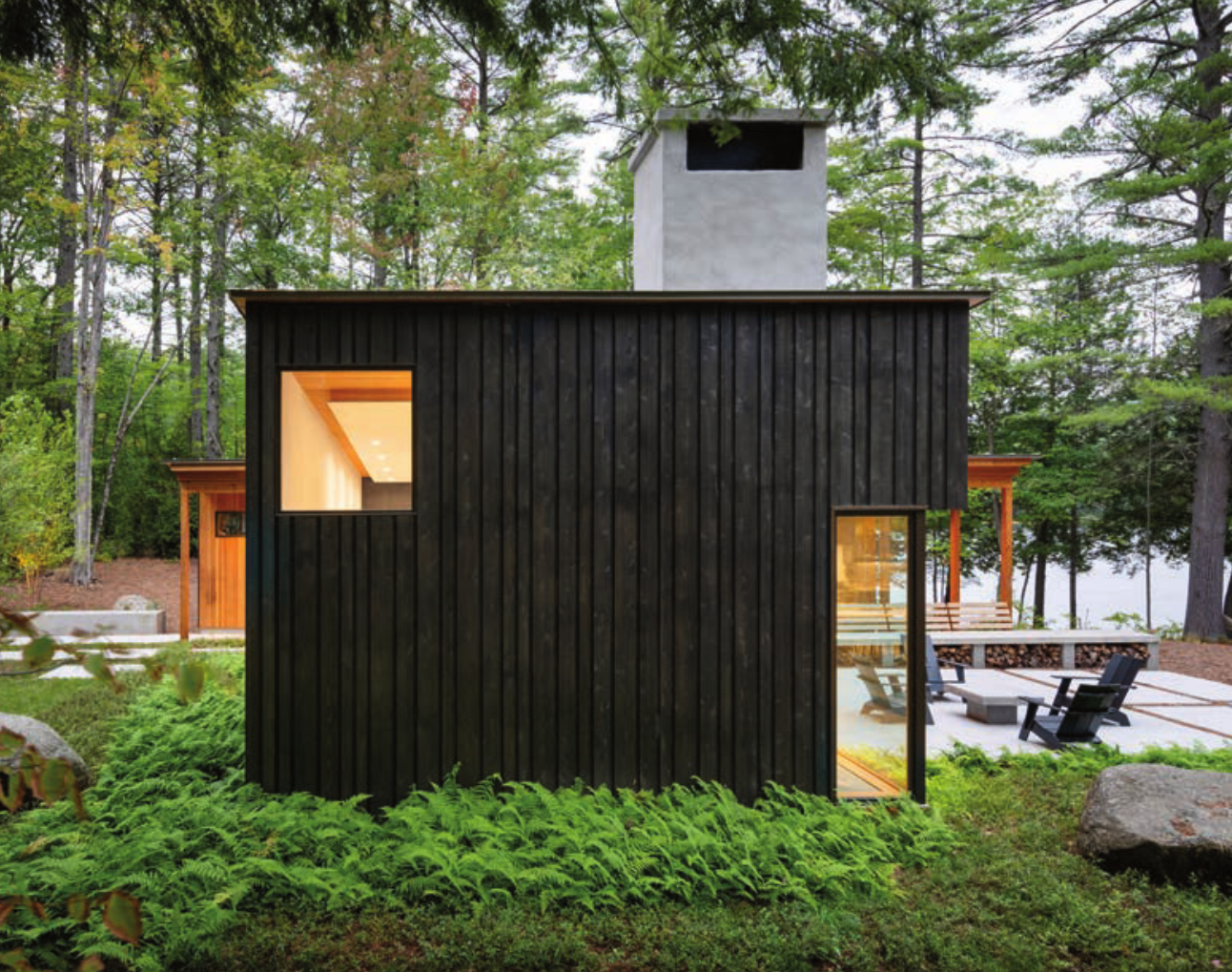
The
experience resulted in a truly unique escape, a stunning, albeit small
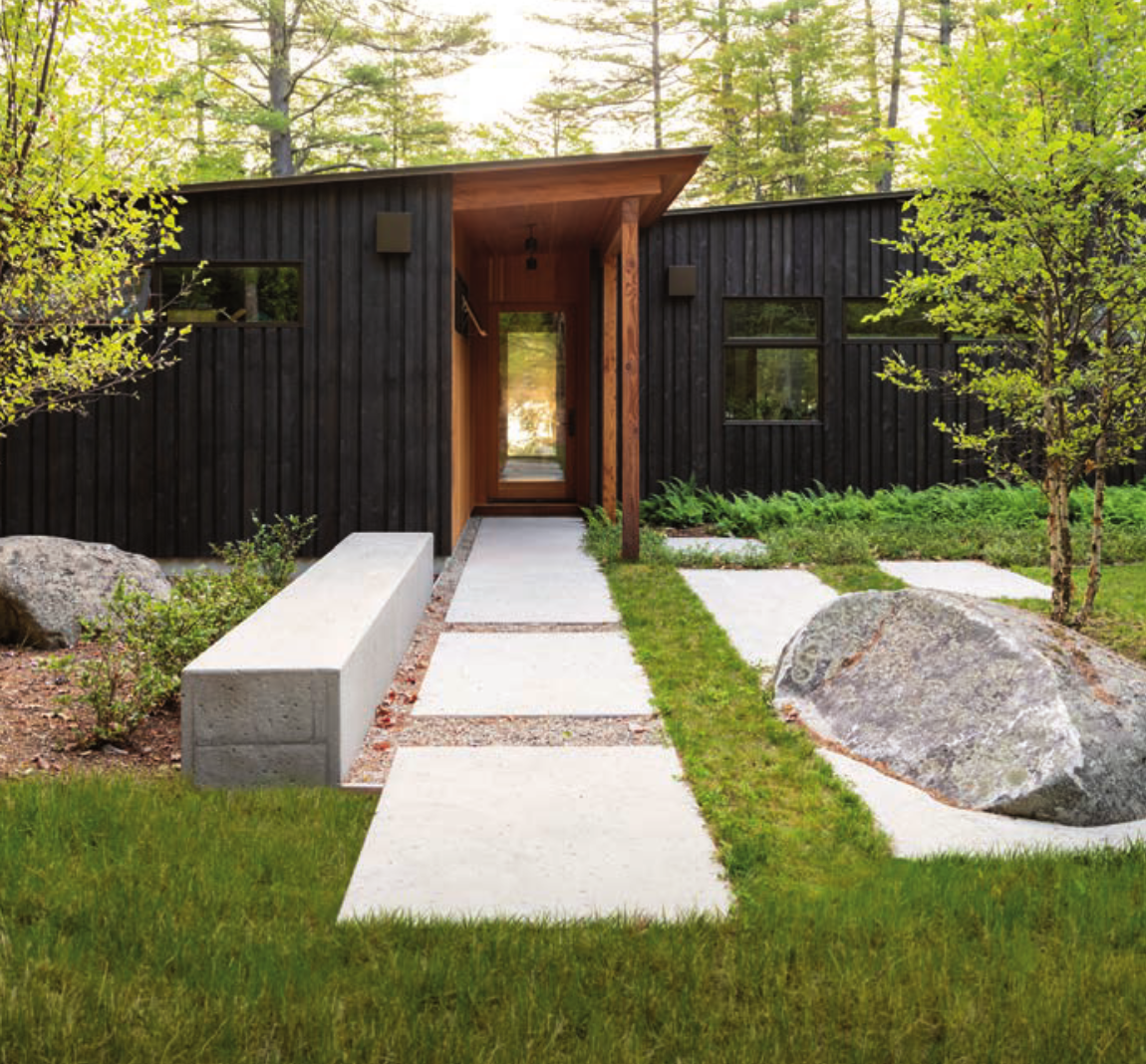
cabin that resembles two tethered shoeboxes, and combines the parcel’s
special sense of place with modern design and building techniques.
Careful choices in materials, stone and landscaping create a sense that the cabin belongs exactly where it is.
“We
built the house farther back from the lake than the original, so we
have a generous amount of open space between the house and the water,”
Charlie says. “Otherwise, the lot is wooded, and features a good number
of fairly old and tall white pines and hemlocks.”
Given
its unruffled, secluded setting, the lake house boasts an unmistakable
“hidden gem” quality. It offers roughly 1,300 square feet of living
space, with open-concept living, kitchen and dining areas, two bedrooms,
and 1.5 bathrooms (plus an outdoor shower, which is one of Charlie’s favorite
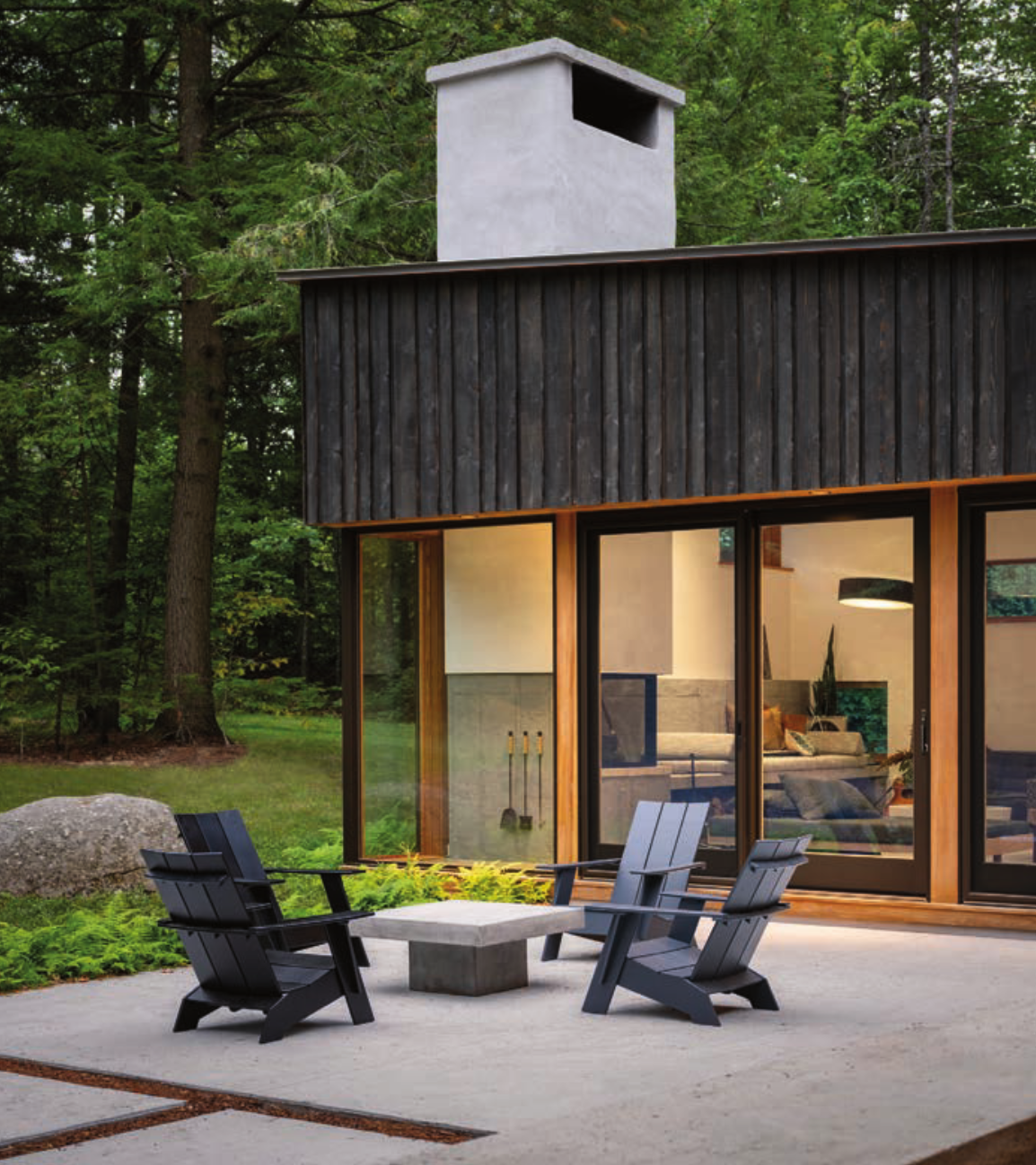
features). An impressive, two-sided fireplace is integrated with a
polished cement bench that anchors the sitting area and provides wood
storage. All the floors are polished cement with radiant heat, keeping
the structure warm during the winter and cool in summer. The plaster
walls are unpainted, giving the living space a textured feel.
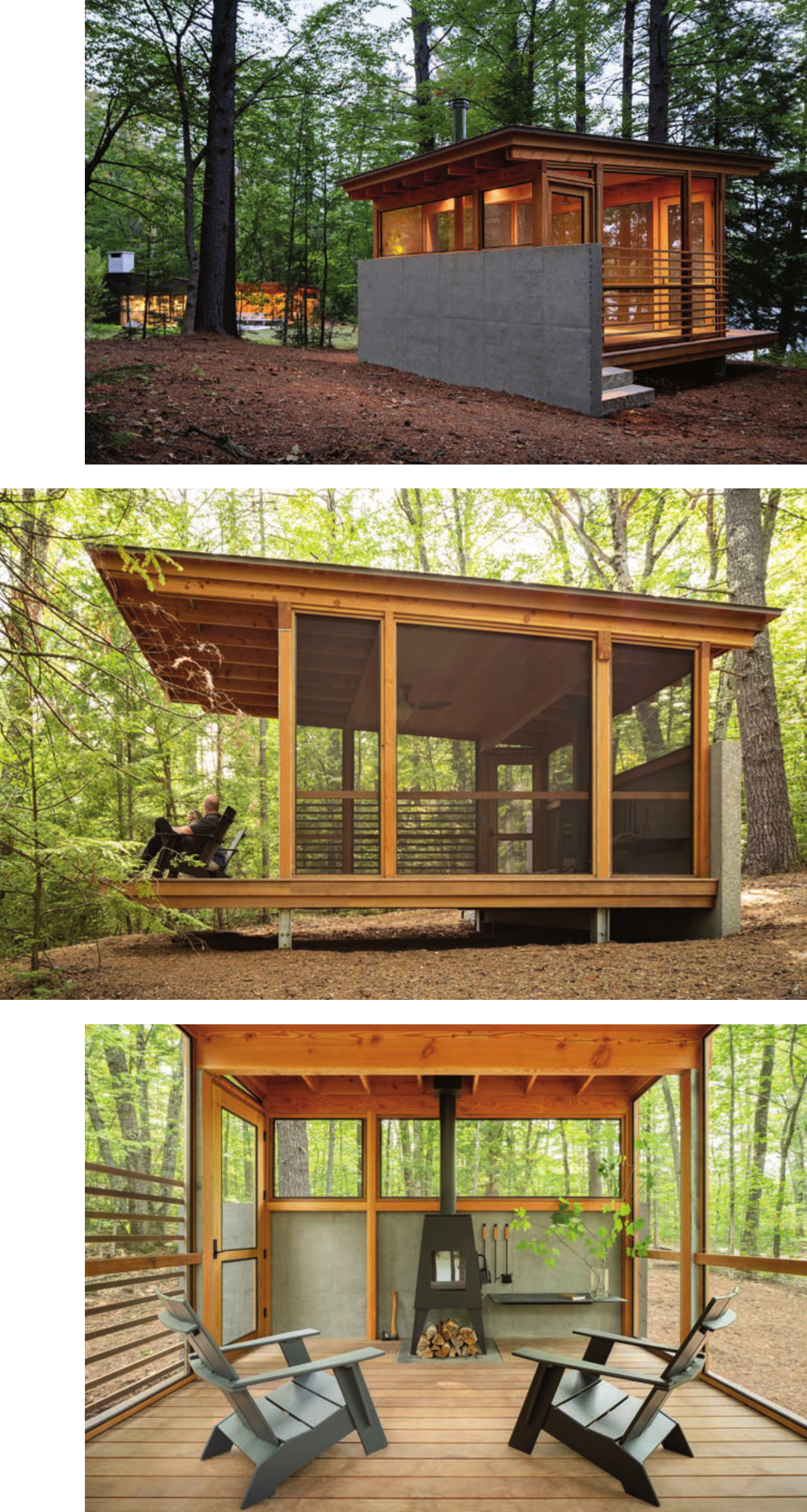
“We
also built a separate screen porch that’s about 30 yards from the
house, closer to the lake,” Charlie says. “That structure is anchored by
having one cement wall, against which is a small, iron wood stove that
provides very nice warmth in the fall. We now also have a small dock and
a raft, so we can access the lake more easily for swimming and
kayaking.
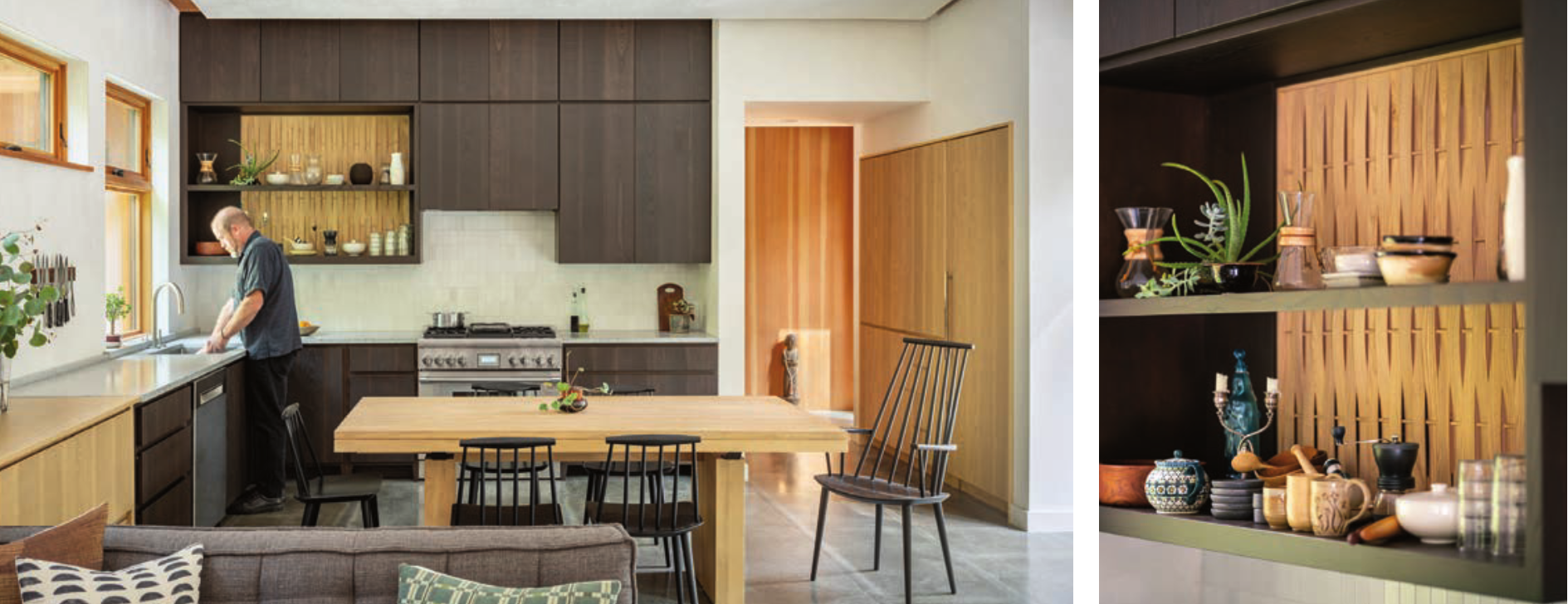
“The idea
was to have very little ‘stuff’ at the house, so while there are
built-in drawers in both bedrooms, there are no closets and no mudroom,”
he says. “The concept was ‘you come, you throw your bag on your bed,
and you just enjoy the lake or cooking a meal, or sitting out by the
fire.’” For Rob Whitten, founder of Whitten Architects, the chief goal
of the project was “to have the whole be greater than the sum of the
parts.” The challenge, he says, was to “to meet the spatial needs of the
owners and have the design respond to the specific conditions of the
site,” including the natural sunlight, views, lake, slopes and
topography, natural features, and existing trees and ground cover.
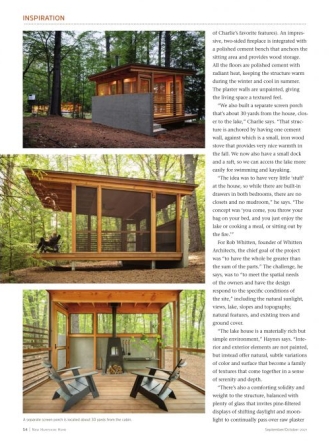
A separate screen porch is located about 30 yards from the cabin.
“The
lake house is a materially rich but simple environment,” Haynes says.
“Interior and exterior elements are not painted, but instead offer
natural, subtle variations of color and surface that become a family of
textures that come together in a sense of serenity and depth.
“There’s
also a comforting solidity and weight to the structure, balanced with
plenty of glass that invites pine-filtered displays of shifting daylight
and moonlight to continually pass over raw plaster specific design,” says
Lane, the project architect. “We wanted to deliver a design that had the
architectural qualities they were looking for as well as the durability
and performance qualities that aren’t seen.”
Lane
says Charlie and Haynes “challenged and invited us to design a home of
modest size that was wabi-sabi meets Shaker in sensibility.” Wabi-sabi
is a Japanese design philosophy that emphasizes finding beauty in
nature’s walls, natural wood surfaces, shining polished stone-like
cement floors, rough cement elements, and soft wool, linen and velvet
cushions and comforting furnishings and blankets in muted rich tones,”
she says. “This is a place to be still and surrounded by quiet comfort.”
The finished product highlights the collaborative effort of the project.
“Our
goal was to help our clients achieve their vision in a way that brought
to bear our expertise in site imperfection, while traditional Shaker
architecture is characterized by clean lines and minimalist design.
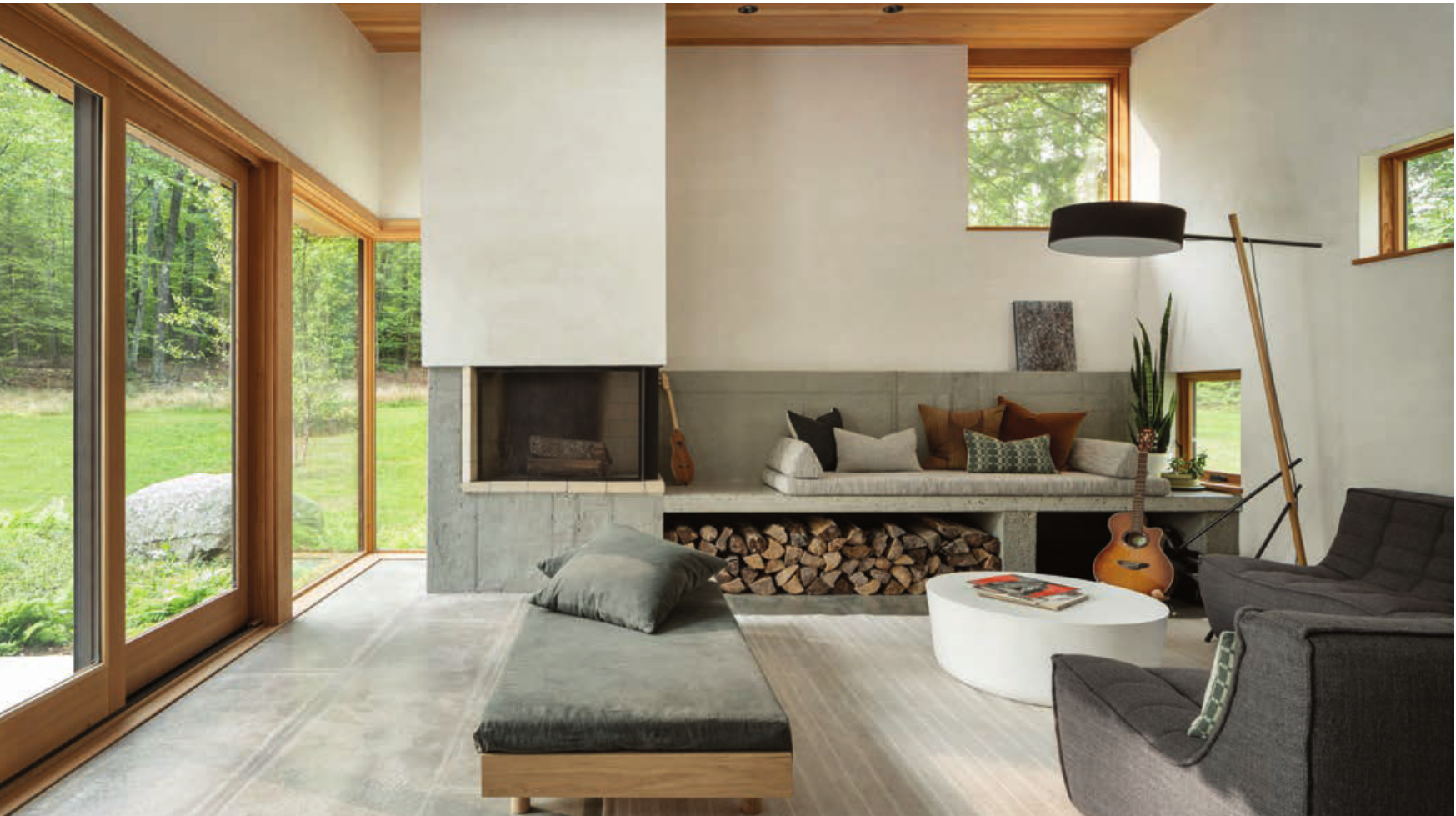
About
1,300 square feet of living space includes a two-sided fireplace with a
bench that doubles as wood storage, and open-concept kitchen, living
and dining areas.
“An
example of wabi-sabi in the Loon Lake [home’s] landscape would be the
granite boulder ‘outcrops’ that intentionally interrupt the
poured-in-place concrete slabs at the entry terrace,” deNiord says.
deNiord says he was pleased with “the way the house and terrace spaces flow together,” including the sight lines through the house, the
integrated materials that connect interior and exterior spaces, the
transition to meadow and forest ecotypes, and the strategically placed
granite boulders that anchor the house and form a bridge to the
surrounding landscape.
Hood
also reserved special praise for deNiord, saying he “appreciated the
care that was put into bringing the landscape and surroundings into the
house design.”
“When
you’re in the house, you don’t feel as if you’re inside, but rather a
part of the property,” Hood says. “The house looks like it belongs
there. The stones, landscaping, ferns and screen porch fit the scale of
the landscape to create a sense of coziness and belonging. It’s a much
more sophisticated interpretation of a lake house than what you
typically see.”

Whitten
agrees, adding: “We wanted to use several species of wood and clearly
express the man-made materials, like brick, concrete, glass, steel and
plaster. The [home’s] small size meant that each part of the design
achieved more than one purpose to make the most of the limited space.”
That
limited space was a crucial factor for the builders. “The footprint and
overall design in the house are, at first glance, quite simplistic,”
Hood says.
“When you have a design like that, perfection is key.
“Each
and every square inch must be seamless, since there’s nothing to
distract you from the long, clean lines and subtle details,” he says.
“I’m lucky to have a crew who understands the necessity of taking the
time required to get the details right.”
To
create a hideaway that would withstand the elements, the lake house
utilizes high-performance insulation; prefinished, high-performance
windows; an air-sealing, exterior rainscreen design; and an insulated
radiantfloor slab to minimize energy use, Whitten says. The large
windows were carefully placed to provide balanced, natural light.
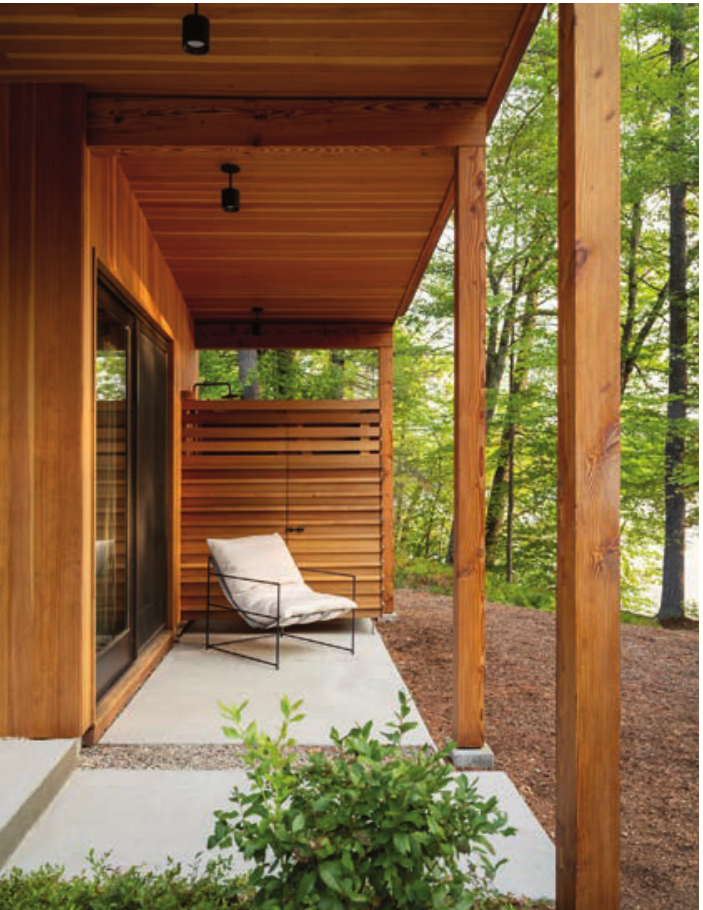
A
connection between interior and exterior spaces is a key concept, and
the bedroom is no exception with its large doors that lead to an outdoor
sitting area.
“The
plan has a central core of utilities, and the bedrooms and living
spaces are separated for privacy,” he says. “The interior living spaces
open to a landscaped courtyard, which is a protected sun pocket that
extends the outside living beyond the summer months. The small
wood-burning fireplace provides an interior focus and is a cozy source of heat on cold nights.”
Although
she came to the project later, interior designer Lachapelle emphasizes
that the project’s collaborative effort never skipped a beat. “We wanted
to ensure that the interior furnishings and fixtures matched the artful
nature of the architecture,” Lachapelle says. “When we joined the
project, there was a strong aesthetic path that the team was headed
down, so it came together very effortlessly on our end. With the smaller
footprint, we had to be very selective with what pieces were absolutely
necessary to articulate the aesthetic.”
Outside,
deNiord says he was tasked with creating “a beautiful—and beautifully
crafted—lakeside retreat with a strong indoor-outdoor connection that
could be used throughout the seasons.” That meant a low-maintenance
landscape with a “native plant palette,” with a flowing traffic pattern
and strong sight lines to the lake, he says.
Mission accomplished, say Charlie and Haynes.
“We’re
extremely happy with how it came out,” Charlie says. “One of our goals
was to create a space that not only blended with the landscape, which we
think it does, but also created a kind of integration between the
inside environment and the natural world outside.
“That
central hallway, the overhanging roofline and the huge windows—
especially in the kitchen, living area and main bedroom—all helped to
give the space that kind of flow-through feeling,” he says. “Now that we
are using the space more as it was originally designed, we feel like it
functions just as we’d hoped.”
Although
the property was purchased with the previous owner’s older home
on-site, the structure couldn’t be salvaged. Undeterred, and with an
appreciation for the property’s history, Charlie and Haynes preserved
several large chunks of granite from the house’s hearth as the backstop
for their new fire pit.

“We
had a lot of affection for the old house that was there when we bought
the place,” Charlie says. “Being able to use one of the key components
of that house—the granite hearthstones—in such a visible way was
important to us, as a sign of respect for what came before us. I love
seeing the stone there each time we arrive at the house.”
The
couple’s sense of accomplishment was shared by their team of talented
professionals who came together, listened attentively and employed their
own expertise to create a memorable place.
“I’ve
built many houses in my life, but this one will really stand out for
its artistic value,” Hood says. “Building this house went beyond
numbers, measurements and figures—it’s a work of art.
“It’s
not about marble countertops, square footage or an in-home theater,” he
says. “Charlie and Holly set out to do something special, and it was
incredibly rewarding to be a part of making something so unique.” NHH
RESOURCES
Heidi Lachapelle Interiors • (207) 620-0300
K.P. Hood Construction • (603) 455-8680
kphoodconstruction.com
Soren deNiord Design Studio • (207) 400-2450
sorendeniord.com
StandFast Works Forge • (207) 625-4486
sfwforge.com
Whitten Architects • (207) 774-0111
whittenarchitects.com