Room for the Heart
Emotions aside, home is where your stuff fits.
MY FIRST HOME (after leaving my parents’ house) was a closet.
I’d just moved 150 miles to the west of my family in northwest Florida to attend a junior college in Tallahassee, riding the matriculation wave with some of my more academically gifted friends who were going to FSU.
We shared a Victorian house on College Avenue with a big, glazed-tile fireplace but not many bedrooms. Hanging off the back of the house was a large sleeping porch—a lovely Southern innovation for summer nights before air conditioning. The porch was walled by screens fitted with big, wooden jalousies to shut out the night air, but you could hear the sorority and frat parties late at night. That cool space had been claimed, but between it and the rest of the house was a storage closet, about 4 feet by 10 inches, that had its own window. I lived in and out of that space for two semesters. It was my pad. I had a place for everything (I didn’t have much), and tricked it out to my liking with my books, a table and a teapot. I could even entertain a guest or two.
My experiment in independent living didn’t last long. I was soon back at my parents’ house, with all my stuff but sans diploma, to ponder my options for the future.
My current home, in which I’ve now lived for half my life, was where my mother-in-law was raised and courted by my father-in-law. When my wife and I were newlyweds, this 200-year-old farmhouse—situated in the heart of the Capitol City of a strange, distant land known as New Hampshire— was offered to us if we would simply move 1,000 miles north and be companions for my wife’s grandparents during some of their final years.
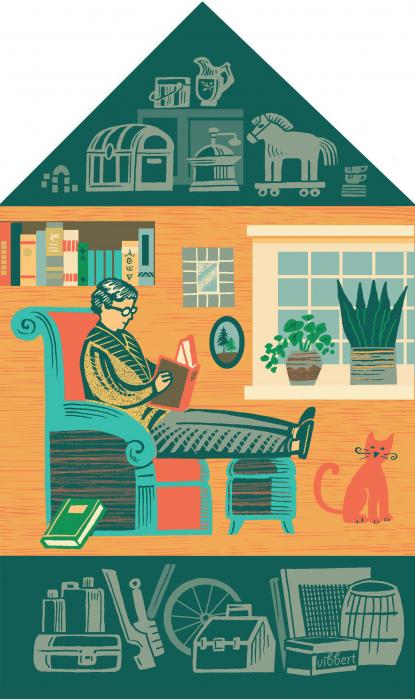
By the way, such
multigenerational nesting is currently all the rage. A recent Pew Center
poll determined that as a result of the COVID-19 pandemic, 52% of
people ages 19–28 were presently living with their parents or
grandparents—the largest percentage since the Great Depression.
Moving
our young, growing family into a completely furnished (and occupied)
home seemed a bit like the opposite of my college closet dwelling. We
still had to find and make room for our stuff, but most of the spaces
were already full of sentimental treasures and décor that had been a
constant for a generation or two. Eventually, we found a place for
everything and tricked out our space to our liking. We even had guests.
Now
the house is all ours, although the garage and basement have plenty of
vestiges of the past—old tools of mysterious function, anachronistic
oddities (like a big bottle of pure DDT!) and countless forgotten
keepsakes. Add to that the residue of three children, all technically
out of the nest but with quite a few of their own keepsakes (still
precious and remembered) on display here and there.
Home
is indeed where your heart is, but human hearts come with a lot of
baggage. The first step in making a house a home is usually making some
room for it all. And it’s smart to remain prepared for the possibility
that some of your nestlings might suddenly decide to check back in for a
year or three.
The
parsimonious Yankees who designed our house didn’t provide any huge
closets, and those we have are full. But, hey kids, the mudroom is large
enough for a pallet and dresser.
By Rick Broussard | Illustration by Carolyn Vibbert


