The Pocket Gardens of Portsmouth
Homeowners
Janet Prince and Peter Bergh hired Terrence Parker of Terra Firma
Landscape Architecture to turn their tiny open space into a relaxing
retreat.
This annual tour offers inspiration for small-space gardening.
After last year’s Portsmouth Pocket Garden Tour—an annual tradition on the Seacoast since 1989—was delayed until September due to COVID-19 concerns, co-chairs Susan Peterson and Lauren Katz have decided to return the tour to June this year.
“It’s the beginning of the growing season, gardeners can get ideas for their own gardens and have time to implement them, and it’s a wonderful way to start the summer season in the Seacoast,” they say.
The self-guided walking tour of South End properties will feature six gardens from previous years and six new ones. This is a major fundraiser for the Unitarian Universalist South Church, which will be getting a new slate roof this summer.
Due to the construction work, home base for the tour— which normally
begins at the church—is expected to be at Strawbery Banke Museum’s
Puddle Dock. “We are looking forward to sharing the South Church Pocket
Garden Tour with those who’ve visited before and with newcomers,” say
Katz and Peterson.
There
are many issues to overcome when gardening in a small space, but the
rewards outweigh the work involved, leading to some surprisingly
beautiful results.
The
Pocket Garden Tour offers a chance to see how some innovative gardeners
in Portsmouth have risen to the challenge. Last year’s tour highlighted
homes in the Middle Street area. Here are a few.
From problems to possibilities
Janet
Prince and Peter Bergh resurrected their home and garden from a
severely neglected property on Lincoln Avenue. (Read the story of their
home renovation project in the January/February 2018 issue of New Hampshire Home.) “There
was no garden at all, and the house and yard were in blight condition,”
Prince says. A huge wisteria vine had taken over the back of the house,
where it burrowed under the clapboards and was starting to grow through
the second-floor windows.
Prince
and Bergh called on landscape architect Terrence Parker, of Terra Firma
Landscape Architecture in Portsmouth, to transform the tiny open space
wedged between the back of the house and the garage into a relaxing
retreat. “The roots that had run rampant from the wisteria vine were the
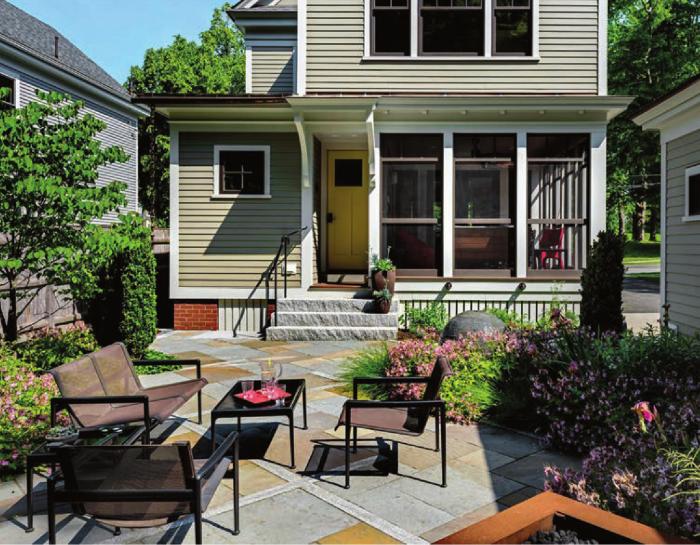
inspiration for the paving pattern,” says Parker, who replicated the
design in cut bluestone. “The wisteria roots led me to create linear
elements in the stone pattern of the terrace that suggested a look of
structured wildness,” he explains.
In
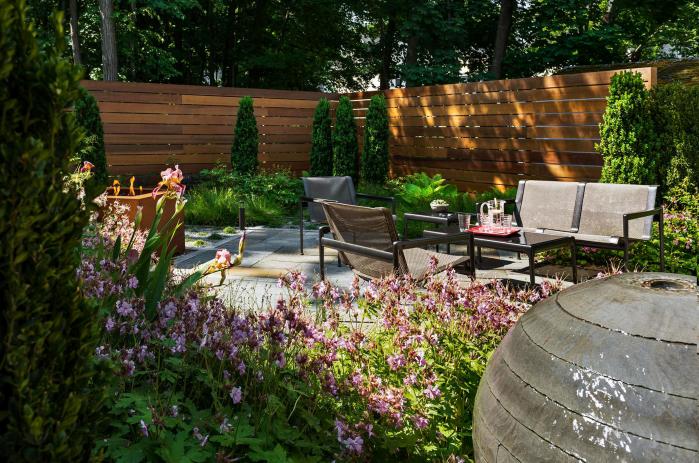
the angled beds around the perimeter of the terrace, Parker has planted
many shade-loving plants, including ferns, hostas, astilbe, heucheras,
aruncus, actaea and perennial geraniums. Upright Japanese “Sky Pencil”
holly bushes provide vertical elements along the 6-foot high,
horizontal-cedar-board privacy fence. An Eastern redbud provides some
shade. “The terrace is mostly shady, but in the summer, they get mid- to
late-afternoon direct sun for a few hours, hence the need for the
redbud,” Parker says.
The terrace is in shade during much of the day, so the angled flower beds are filled with shade-loving plants.
Fire
and water are represented with a custom-designed, spherical bluestone
fountain and a square, Cortensteel firebox. “[Prince and Bergh] also
wanted the suggestion of a barrier from the abutting park,” Parker says.
“That planting had to remain open for their view out into the borrowed
landscape, so highbush blueberries were used to line one side of the
driveway, forming an edible hedge.”
Dwarf
hinoki cypress and amsonia flank the front steps, and next to the back
door, there is a large, raised bed full of herbs and vegetables. “My
husband is a great cook,” says Prince, “so we grow tomatoes and have an
herb garden.”
Living large in small spaces
When
Nancy and Brian Pearson moved into their townhouse in 2011, roughly 90%
of the yard was asphalt. “It went from the street, to the foundation,
around the garage and wrapped around the other side. It’s a two family
house, and our side is about a tenth-acre. We kept just enough asphalt
to park our cars and dug up the rest,” Nancy says.
The
couple kept half the space as open lawn for their dogs to enjoy and
enlisted the design services of Jacquelyn Nooney to create two outdoor
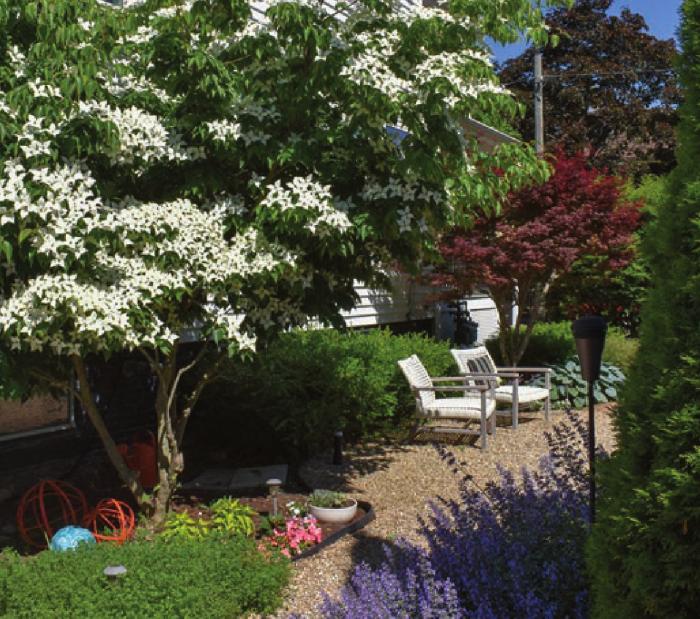
rooms in the other half. “One is for dining, where we chose a travertine
patio and planted an ivy wall on the garage to give it an Old World
feel,” Nancy says. “The other space was for sitting, where we chose pea
gravel and a custom fire pit/sculpture created by Terrence Parker and
blacksmith Peter Happny.”
The
yard at Nancy and Brian Pearson’s townhouse was once mostly asphalt.
Jacquelyn Nooney turned the space into two outdoor rooms—one is for
dining, and the other (above) became a sitting area with pea gravel and a
custom fire pit/sculpture created by Terrence Parker and blacksmith
Peter Happny.
When
the dogs passed away three years ago, Nancy dug up the remaining piece
of lawn and created a pie-shaped kitchen garden where she grows summer
veggies, such as tomatoes, beans and peppers. “I also have a tiny
orchard now with strawberries, blueberries, peaches and pears. I call it
Tenth Acre Farm,” she says.
Nancy
Pearson likes “the ease and drama of foliage,” so the space is filled
with arborvitae, boxwoods, hostas, peonies, clematis and more.
“I
have a very disciplined philosophy: If it isn’t beautiful or edible, it
isn’t welcome,” Nancy says. “I like the ease and drama of foliage, so
we have these magnificent arborvitae, boxwoods, the wall of luscious
Boston ivy, and perennials like multicolored coral bells, hostas,
peonies, clematis and several apricot Knock Out roses that bloom all summer.”
Inspired growth
Bobbi Slavin has lived in her Portsmouth home for over 30 years.
“When
we moved in, there was no real garden,” she says, “just some
straggly-looking forsythia by the back fence and a few struggling rose
bushes around the porch.”
A
former middle-school art teacher, Slavin is now a professional
photographer. Both fields have given her a great eye for color and
composition, which is evident in her garden design. The lot is long and
narrow, and fairly shady. “At first, I just put plants in randomly. Most
of them died because I didn’t know what I was doing!” she says. “I
quickly learned the benefit of finding out what worked and survived, and
planted them in multiples.”
As
trees have been removed from her own lot and neighboring ones, more
sunlight is reaching into her yard. “There is a bit more sun now, but
the front of the house is still the best spot for the sun-lovers,” she
says.
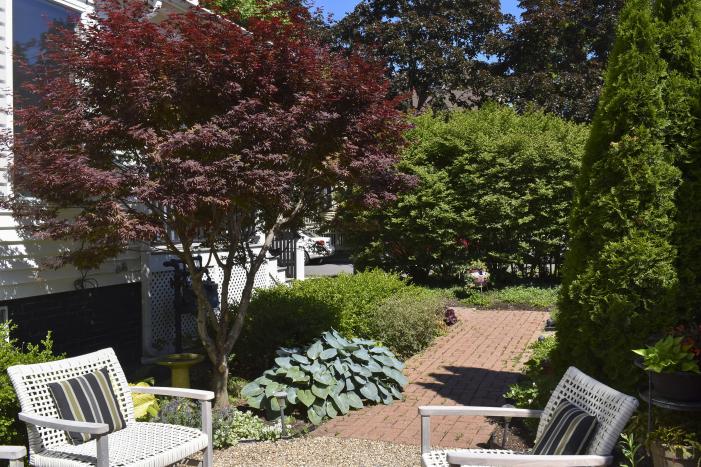
A winding brick path leads
to the patio at the rear of the house. Rather than one large garden,
Slavin has planted many small ones around the perimeter of the yard and
patio, and has built a center island garden in the middle of the yard.
One
of her favorite plants is a rhododendron she bought almost 30 years
ago. “Its size has a grounding effect on the plantings around it,” she
says, “and I have pruned it to a sculptured shape.”
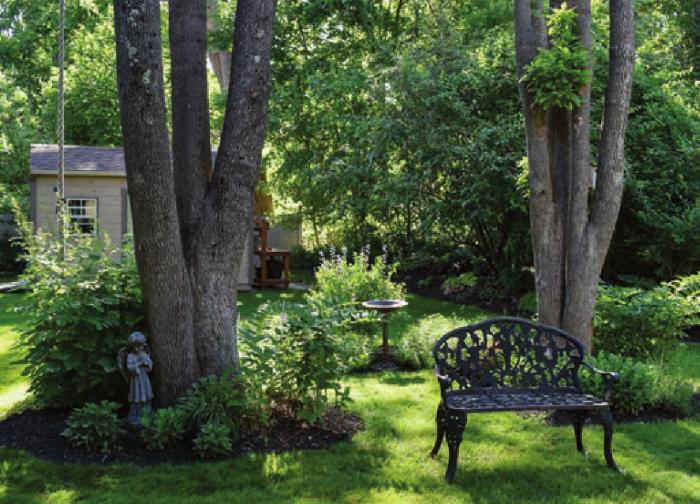
Bobbi Slavin planted many small gardens—rather than one big one—around the perimeter of her yard.
Other
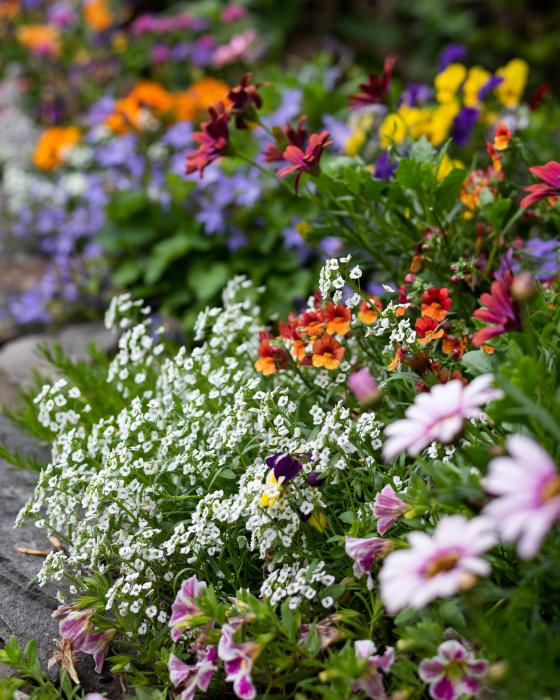
favorites that do well in her growing conditions are hostas, astilbe,
heuchera, coneflowers, rudbeckia, bee balm and Shasta daisies. “I love
my baptisia,” Slavin says. “It is in the island bed, and when the sun
gets behind it and shines through, it is beautiful!” Several clematis
vines and a climbing hydrangea add height to the garden. Slavin has a
30-year-old goatsbeard plant (Aruncus) that is a magnet for bees. “I
have started putting down a lot of groundcovers too,” she says,
“creeping Jenny, different colors of ajuga, some sedums and lily-turf.”
Slavin
collects things like driftwood and shells to use in her gardens, and
has a number of sculptures— angels, frogs and mermaids are favorites—as
well as birdbaths and a small fountain. “We are so close to the ocean,
and there are some beautiful pieces of driftwood that make good
backgrounds for my vignettes,” she says. “I am hopelessly visual and see
my yard as a canvas.”
RESOURCES
Atmos Fire Cages, Portsmouth • (603) 531-9109
atmosfirecages.com
Churchill’s Garden Center, Exeter • (603) 772-2685
churchillsgardens.com
Peter Happny Blacksmith, Portsmouth
(603) 436-4859 • peterhappny.com
Rolling Green Nursery, Greenland
(603) 436-2732 • rollinggreennursery.com
Terra Firma Landscape Architecture, Portsmouth
(603) 430-8388 • terrafirmalandarch.com
Wentworth Greenhouses, Rollinsford
(603) 743-4919 • wentworthgreenhouses.com
The
Pocket Garden tour is more than a chance to stroll through beautiful
gardens, you’ll find inspiration and pick up valuable tips for your own
backyard. See page 86 for event details.
Tips for Home Gardeners
Landscape architect Terrence Parker, of Terra Firma Landscape Architecture in Portsmouth, offers the following suggestions:
• Plant in masses to encourage pollinators.
• Select for great foliage before flowers because leaves are less ephemeral.
• Leave the dead perennials over the winter to create habitat. The world is rapidly losing insects.
• Plant more ferns; they are essential for the green palette and calm the mind.
2021 Pocket Garden Tour
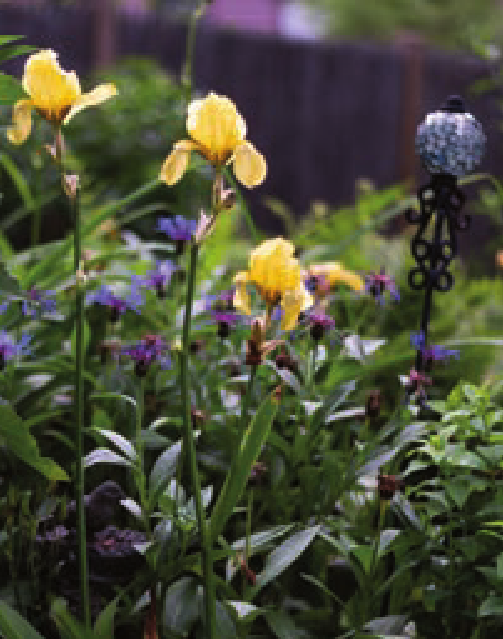
This year’s Portsmouth Pocket Garden Tour is scheduled for 5–8 p.m. on Friday, June 25, and 10 a.m.–4 p.m. on Saturday, June 26.
Tickets
go on sale in early May online at portsmouthnh.com or the Unitarian
Universalist South Church website at southchurch-uu.org. Tickets will
also be available at several Seacoast retail locations.
If
you are feeling hemmed in and limited by a tiny in-town lot, invest in a
pleasant day touring the gardens of the South End. It will be time well
spent. You are sure to pick up some useful tips for transforming your
postage stamp into a mini-paradise.
Follow @portsmouthpocketgardentour on Facebook for details.