Daniel Gordon of LandCare Stone in Madbury and Stratham Hill Stone in Stratham
Q: What are the benefits/drawbacks to a fire pit/table?
A: We love fire features—they’ve become a big part of our product lineup. We sell both types of fire units at our stores and, ultimately, we sell more wood-fired units than gas. Here are the general pros and cons of each:
Gas options are generally more expensive to install and maintain. Be aware that if the unit isn’t frequently used, parts and pieces that sit idle can deteriorate, and will need to be replaced.
Gas has to be professionally plumbed and installed, and a tank needs to be maintained and filled. For our New England customers, wood is generally more accessible.
Our customers tell us that the wood options can be more versatile in terms of cooking or even roasting marshmallows—many prefer wood for that reason.
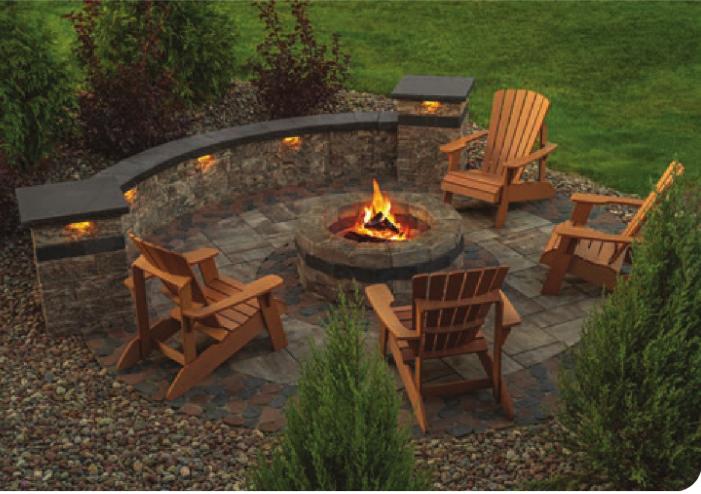
Wood has a different and perhaps more inviting ambiance. The crackle, aroma and warmth of a wood fire is much different than gas. Even on a warm summer night after a day of play, a wood fire is a wonderful spot around which to gather.
Gas, though, does have advantages, particularly if space is tight or you need to be sensitive about proximity to others. Smoke from a wood fire can disturb close neighbors, or can be considered a nuisance in some urban settings.
Additionally, zoning rules will generally stipulate that any feature with an open flame must be located at least 30 feet from the nearest structure. With a gas-burning feature, that distance is sometimes reduced. We caution all buyers to consult their local ordinances regarding fire features, especially if the unit is intended for a permanent setting within the landscape.
Whatever you choose, fire adds something special to a landscape. More often than not, customers who didn’t include a fire feature in their plans often wish they had, and end up adding one later on.
Q: What style of natural landscaping would result in low maintenance?
A: Brick and stone are always considered to be the lowest maintenance portions of any landscape—stone, especially, is the backbone of virtually every landscape the world over. Whether it's the White Mountains of New Hampshire or the sand on our coastal beaches, stone is the backbone and the backdrop—it all started with stone. That said, plants and greenery are what tame the landscape and soften the scene. In terms of sheer maintenance, brick and stone are built to last forever. We sell hundreds of options of clay brick and concrete pavers, and although technology has taught us how to make a better brick, virtually every New England town has a portion of the original bricks that were used to build our landscapes and buildings two to three centuries ago.
Stone is a whole other animal in the world of a natural and lowmaintenance landscape. In those same New England towns, granite, blue stone and the indigenous rocks that make up our very bedrock have been cultivated and used to build everything that New England is known for—and they’re still standing with little or no maintenance.
When we speak with our customers about their projects, we don’t necessarily focus on which brick or stone will last the longest (because they’ll all outlive us), but more on what mood or ambiance they want the landscape to convey, or what that space will mean to them.
Brick and stone each have their own feel and contribution to the spaces we use, and each one presents very differently. More often than not, it doesn’t come down to one or the other, but rather using a mix of both.
Brick and stone work together wonderfully, and when paired with plants, fire features and furniture, the spaces created will be those in which we tend to gather the most. At the end of the day, brick and stone will silently support everything placed in, on and around them, and they ask for little or nothing in return—except to be used and enjoyed.
“Whatever you choose, fire adds something special to a landscape.”
—Daniel Gordon


