A Look Back
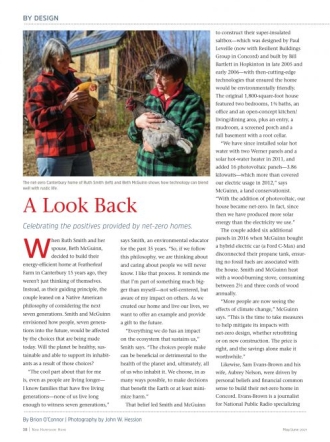
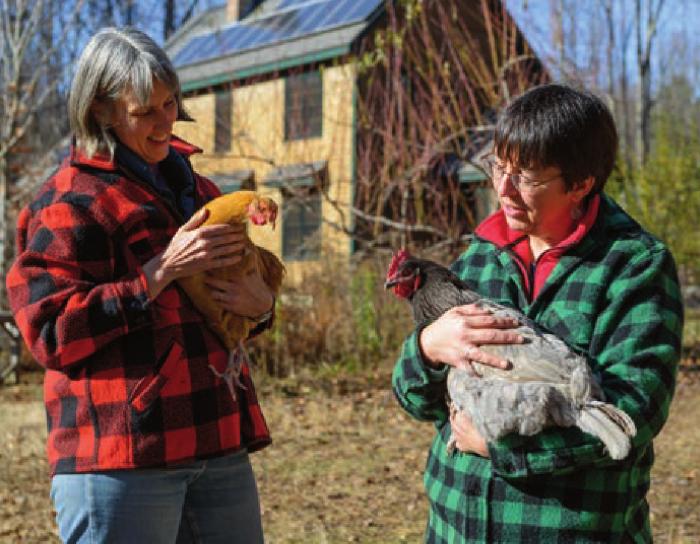
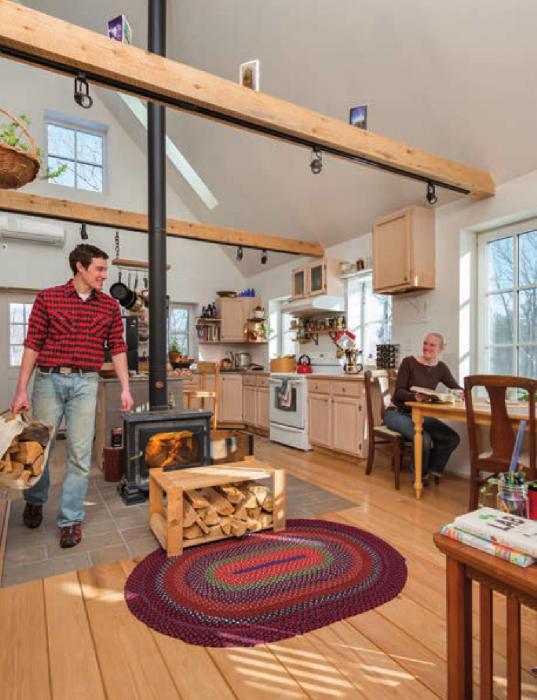
The net-zero Canterbury home of Ruth Smith (left) and Beth McGuinn shows how technology can blend well with rustic life.
Celebrating the positives provided by net-zero homes.
When Ruth Smith and her spouse, Beth McGuinn, decided to build their energy-efficient home at Featherleaf Farm in Canterbury 15 years ago, they weren’t just thinking of themselves. Instead, as their guiding principle, the couple leaned on a Native American philosophy of considering the next seven generations. Smith and McGuinn envisioned how people, seven generations into the future, would be affected by the choices that are being made today. Will the planet be healthy, sustainable and able to support its inhabitants as a result of those choices?
“The cool part about that for me is, even as people are living longer— I know families that have five living generations—none of us live long enough to witness seven generations,” says Smith, an environmental educator for the past 35 years. “So, if we follow this philosophy, we are thinking about and caring about people we will never know. I like that process. It reminds me that I’m part of something much bigger than myself—not self-centered, but aware of my impact on others. As we created our home and live our lives, we want to offer an example and provide a gift to the future.
“Everything we do has an impact on the ecosystem that sustains us,” Smith says. “The choices people make can be beneficial or detrimental to the health of the planet and, ultimately, all of us who inhabit it. We choose, in as many ways possible, to make decisions that benefit the Earth or at least minimize harm.”
That belief led Smith and McGuinn to construct their super-insulated saltbox—which was designed by Paul Leveille (now with Resilient Buildings Group in Concord) and built by Bill Bartlett in Hopkinton in late 2005 and early 2006—with then-cutting-edge technologies that ensured the home would be environmentally friendly. The original 1,800-square-foot house featured two bedrooms, 1¾ baths, an office and an open-concept kitchen/ living/dining area, plus an entry, a mudroom, a screened porch and a full basement with a root cellar.
“We have since installed solar hot water with two Werner panels and a solar hot-water heater in 2011, and added 16 photovoltaic panels—3.86 kilowatts—which more than covered our electric usage in 2012,” says McGuinn, a land conservationist. “With the addition of photovoltaic, our house became net-zero. In fact, since then we have produced more solar energy than the electricity we use.”
The couple added six additional panels in 2016 when McGuinn bought a hybrid electric car (a Ford C-Max) and disconnected their propane tank, ensuring no fossil fuels are associated with the house. Smith and McGuinn heat with a wood-burning stove, consuming between 2½ and three cords of wood annually.
“More people are now seeing the effects of climate change,” McGuinn says. “This is the time to take measures to help mitigate its impacts with net-zero design, whether retrofitting or on new construction. The price is right, and the savings alone make it worthwhile.”
Likewise, Sam Evans-Brown and his wife, Aubrey Nelson, were driven by personal beliefs and financial common sense to build their net-zero home in Concord. Evans-Brown is a journalist for National Public Radio specializing in environmental issues, while Nelson works for a nonprofit that teaches children about the country’s electrical grid. Building a net-zero home, Evans-Brown says, was “partially about our belief about the future and what the world needs.”
“You can’t study climate and energy very long without getting freaked out about the scale of the problem and the daunting nature of scaling up the solutions we have already,” he says. “That says, financially, it’s a really good choice.” He adds that in his opinion, homeowners would be wise to integrate at least some of the available environmentally-friendly design options that are currently available.
Evans-Brown and Nelson played it smart, finding an “amazing” spot within the confines of the Granite State’s capital city.
“We’re four miles from my office and Main Street, but have miles of trails and hundreds of acres of woods out our back door,” Evans-Brown says.
“We actually felt conflicted about building new at first, since renovating existing housing stock is a more important challenge to tackle, when it comes to energy and climate,” he says. “But the spot was too good of an opportunity to pass up.” Also, Evans-Brown and Nelson opted to build instead of renovate “because the type of home we wanted virtually doesn’t exist—small, efficient, close enough to town to bike or walk,” he says.
“I know enough about this subject to know that buying an existing home and making it net-zero would be really, really expensive,” he says. “Not that our route was cheap.”
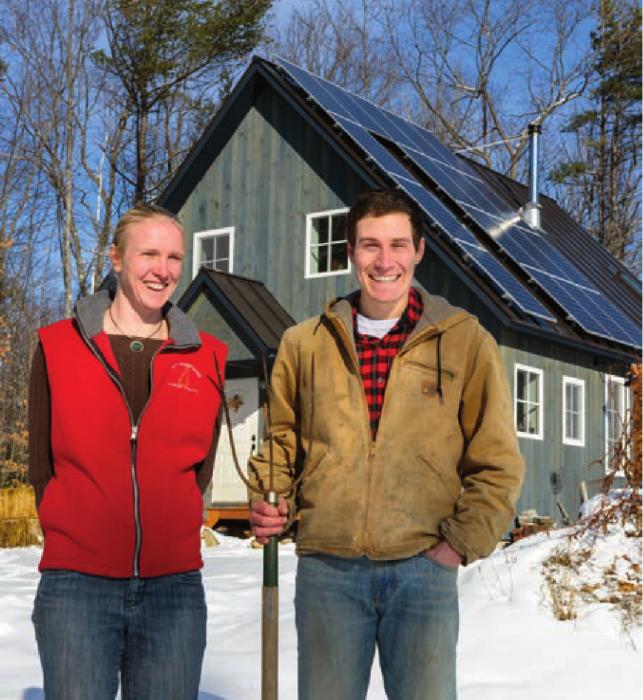
Aubrey Nelson and Sam Evans-Brown outside their net-zero home in Concord
The resulting home the couple share with their two young children—built in 2015 by R.H. Irving Homebuilders in Salisbury, New Hampshire—currently boasts one bathroom and two bedrooms, with a basement that may eventually house a second bathroom and third bedroom (“We’re getting there,” Evans-Brown says).
The design, Evans-Brown says, is based on a concept that some Maine builders are calling the “Pretty Good Home,” where architects and builders continuously go above and beyond building code requirements, as much as they can before it no longer makes financial sense.
“The main features are that the building is super-insulated, was meticulously air-sealed, has more windows on the south-facing side to catch the winter sunlight, is all electric and has solar panels” that are tied into the grid, Evans-Brown says. “Honestly, this approach isn’t rocket science. The house is a ‘double-stud wall’—meaning there are two 2-by-4 walls, with a little 2-inch gap between them, and the whole cavity is filled with dense-pack cellulose insulation, [which is] shredded newspaper.”
Asked what feature provided the “biggest bang for their buck,” he replied with a single word: “insulation.”
“We probably spent an additional $10,000 on insulation and maybe $10,000 on the framing. Those investments, along with the solar, are what make it possible for us to have essentially zero energy costs,” Evans-Brown says. “If you just do solar without the insulation, you’ll wind up spending a lot more on your heating equipment and your solar array. Shredded newspaper is cheaper than monocrystalline silicon [the material used in modern solar cells].”
Nelson added that “air sealing,” or creating a “tight envelope,” is another critical component to an efficient, netzero home. “Plug those holes in your house,” she says.
“Programmable thermostats and appliances—water heaters especially—also make a big difference, because you can turn down the heat when you don’t need it,” Nelson says. “Also—and this is a big thing if folks are buying or building new—the smaller your house, the easier it is to heat, clean, etc. Smaller houses are a big bang for your buck.”
The couple’s home is heated by a coldclimate, air-source heat pump, which is gaining popularity in “how to decarbonize heating,” Evans-Brown says. They also make use of a wood stove, which Evans-Brown admits is “a no-no in some net-zero definitions.”
“It’s been tricky,” he says. “The house doesn’t generate a great draft, because it’s so airtight. Operating the stove has a steep learning curve. We’ve smoked ourselves out of the house more than once, and have bought an air purifier to make sure we’re not breathing too much smoke. If someone else is using the house, [we suggest] they just run the heat-pump.”
After paying close attention to energyefficient details during the building phase, Evans-Brown and Nelson have since enjoyed considerable savings— spending less than $400 over five years on cord wood to heat their home.
“Most of the wood we have burned has come from trees that have blown down on our property,” Evans-Brown says. “So, in the five years we’ve lived here, you can reasonably estimate we’ve saved almost $20,000.”
Their house and their family budget have also benefited from the structure’s orientation. “A south-facing aspect does a lot of work to passively heat even a conventionally designed home,” he says, adding that society, in general, “used to know this.”
“Look at old saltbox houses—the ones built back when energy was genuinely scarce,” he says. “The tall side faces south, to catch that lowangle winter sun.”
At the time Smith and McGuinn built their home in 2005, it was so groundbreaking that they once hosted tours.
A decade earlier, Smith and Mc-Guinn made a similar siting choice, acknowledging that “location is key,” Smith says.
“Beyond convenience to our jobs and center of community, when we were looking for land, we sought a plot that would be conducive to a solar home,” she says. “Southern exposure was obviously a key element to that.
“Although we looked at some open land, having a forested lot was appealing because we imagined using our own wood for some of the construction. Beth is a forester by training, so it was her dream to do that,” Smith says. “We were torn about removing wildlife habitat to create our own habitation. But knowing that the land was being sold as a house lot, we justified our purchase by creating the most sustainable home we could afford and minimizing the impact around the developed area.”
At the time the couple’s home was built, it was so groundbreaking that they initially hosted tours. (Their 2005-era technology has since been surpassed by even more efficient designs.)
“We wanted the house to be a place to teach how to build a passive solar, energy-efficient home,” McGuinn says. “We’ve taken literally hundreds of people through our house to discuss its construction and how we live in it.”
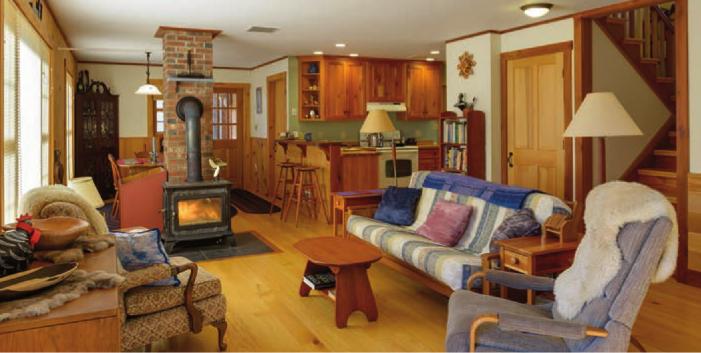
Smith says the benefits of a net-zero home—even one that’s a little dated— are numerous, starting with the obvious financial savings garnered from the solar panels that produce more than enough electricity for their house and gaselectric car and solar hot water. Additional green features include a soapstone stove that uses wood harvested from the couple’s land, copious insulation, double-pane windows, large windows on the structure’s south side and airlock doors. All these features make the house more efficient and easier to heat.
But there is also a keen satisfaction that Smith and McGuinn have—as they live in a more self-sufficient way and work together with Mother Nature to be good stewards of the planet. This requires adjusting behavior as well. “Turn things off when not in use, utilize power strips, shorten showers, install low-flow water faucets,” Smith suggests.
“Whenever I hear about the existential threat of climate change, I know we are doing more than the average homeowner to mitigate that and I want to encourage everyone to do more,” she says. “We really don’t have much time left to turn the corner on climate change. It’s already happening, and unless everyone commits to reducing their consumption of fossil fuels, we will see a very different future than the one we’d like to see.
“I don’t want to be contributing to that scenario,” Smith says. “I want to be part of the solution, not part of the problem.”
There are, however, some obstacles to energy-efficient homes, Evans-Brown says. The home-building industry hasn’t always been quick to adopt or embrace new design and building techniques, regardless of the benefit to the planet.
“Contractors and subcontractors are generally small-business folks who do a couple houses a year,” Evans-Brown says. “They do things the way they know and like how to do things, and resist what they perceived to be fads.
“More insidiously, building trade groups fight changes to building codes that would make some of these design changes that pay for themselves very quickly, as our case demonstrates,” he says. “This makes it easier for those in the industry to build and to sell new houses, but it’s bad for the climate, for the long-term finances of homeowners, as well as for their health and comfort.”
Evans-Brown recommends a single website to anyone considering building an energy-efficient, environmentally friendly new home or even renovating an older home: NHSaves.com. A collaboration of New Hampshire’s electric and natural gas utilities, NHSaves provides residents, businesses and towns with information, incentives and support designed to save energy, reduce costs and protect the environment. The clearinghouse is “funded by electric and natural gas ratepayers, and delivered by Eversource, Liberty, New Hampshire Electric Cooperative and Unitil to make our homes, businesses and towns more sustainable and more comfortable places to live and work, both now and in the future,” according to the NHSaves website.
Evans-Brown and Nelson’s home is heated by a heat pump, although they also use a wood stove.
Evans-Brown encourages all New Hampshire homeowners to take advantage of the state’s energy-efficiency program. “The state will pay you 75% of the cost of energy-efficiency improvements, up to $8,000. This includes insulation, air-sealing and other things you need to tighten up your house, including things like bathroom fans.
“We took advantage of Energy Star for New Homes, which cut us a $4,000 rebate check for building a more efficient house and connected us with an energy auditor,” he says. “We also got rebates on the more efficient appliances we bought, the heat pump and our water heater.”
Both couples exemplify a willingness to share information, enabling others to take advantage of new technology and funding provided by private and public grants.
“For us, the financial savings [of a net-zero home] were a bonus, but we did it because solar embodies who we are—people who care about the land and the environment, and who understand that fossil fuels were meant to stay in the ground,” McGuinn says. “In the ’70s climate change was not on my mind, but today, we think about and experience its impacts every day.
“I sleep better at night knowing that I’ve not only reduced my carbon footprint, but shared my experience to make that action more accessible to others.”
“The choices people make can be beneficial or detrimental to the health of the planet and, ultimately, all of us who inhabit it.”
—Ruth Smith