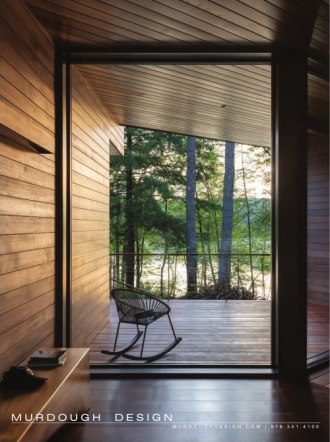
Memories Made Real
 Restoring a home preserves more than just a building.
THERE’S A CERTAIN KIND OF MAGIC THAT HAPPENS when a place is imbued with happy memories. Through the eyes of someone who has learned to love it, most anything can become something more than it really is. Flaws aren’t just overlooked—they’re smoothed into becoming part of the charm; they’re transformed into the unique quirks that make your place unlike anything else.
When I was little, my mother’s parents and I had a spot—the Village Café in Portland, Maine. And we had rituals: I would ask a bemused (I hope) waitperson to bring my grandfather a “hanmattan” (Manhattan in non-small-child speak) with extra cherries—the not-seen-innature red kind—which my grandfather scooped out and gave to me. My usual was penne with sauce on the side, into which I oh-so-carefully dipped my pasta (losing one off the fork was an ever-present danger), and when we left, I always checked the pay phones for any forgotten change. And, yes, pay phones, plural.
I was genuinely sad when the Village closed in 2007. The regulars were fading, competition was fierce, and Old Port real estate was quickly becoming a precious commodity. Eventually, to make way for the new and trendy, the Village, with its endearing-to-me cheesy décor, oldschool food and utter lack of pretension, was pushed aside. Maybe such progress is inevitable, but there’s a cost that should be considered, or at least acknowledged, even if the outcome ultimately remains the same.
Vincenzo Reali opened the Village Café in 1936, and it stayed in his family for its entire seven decades of existence, passing down from father to son to grandson. In a city quickly changing to adapt to new tastes, a family lost a piece of their history.
In this issue, a beloved family home happily meets an entirely different fate.
When Deborah Coffin was considering her family’s summer house on Lake Winnipesaukee (see story on page 52), her goal was to preserve the past while making way for the new. Rather than demolish the original and start fresh, as happens so often on the shores of our picturesque lakes, her love for the home—flaws and all—let her see the potential for something special.
The house, called Two Pines, has been in her family since it was originally built in the 1900s. Some of her earliest memories, she says, include summers there, catching bass from the family’s boathouse and enjoying their piece of waterfront. It’s the place she remembers fondly, not just for the location but for the time spent with her grandparents.
There was no doubt Two Pines, which had undergone some changes in the 1970s, needed some major updates. However, the mission from the start, says Coffin, was to restore the house to the much-loved place of her childhood.
While working on the story, it struck me that this is where Coffin had her version of “hanmattans” and fastidious pasta-dipping, but she had the chance to ensure those memories lived on in more than just her heart—and she took it.
Coffin and the design team found family heirlooms in the attic, including an old wooden propeller that likely belonged to Coffin’s grandmother, Betty, the first woman to earn a pilot’s license in Connecticut. The propeller now hangs on the wall of the children’s room, which is also adorned with photos of Betty and the many planes she flew.
Such connections to family abound in Two Pines, where new memories can be made while surrounded by precious reminders of the past, and traditions can continue in the place they were formed. That’s special, indeed.