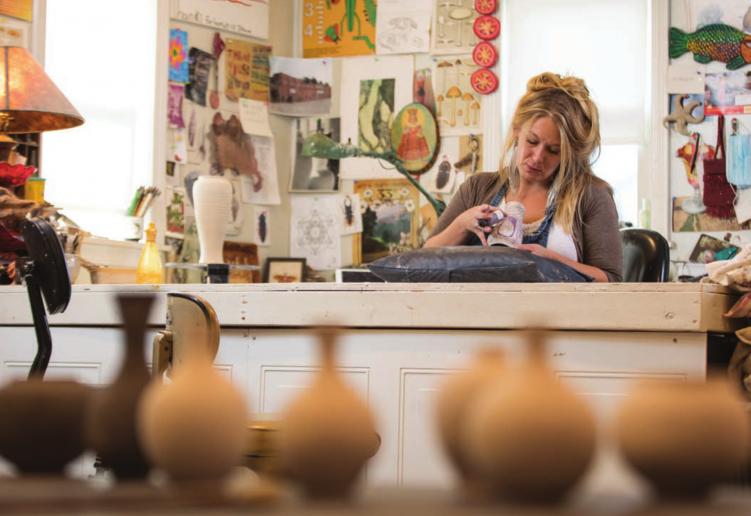
Expressions in Porcelain
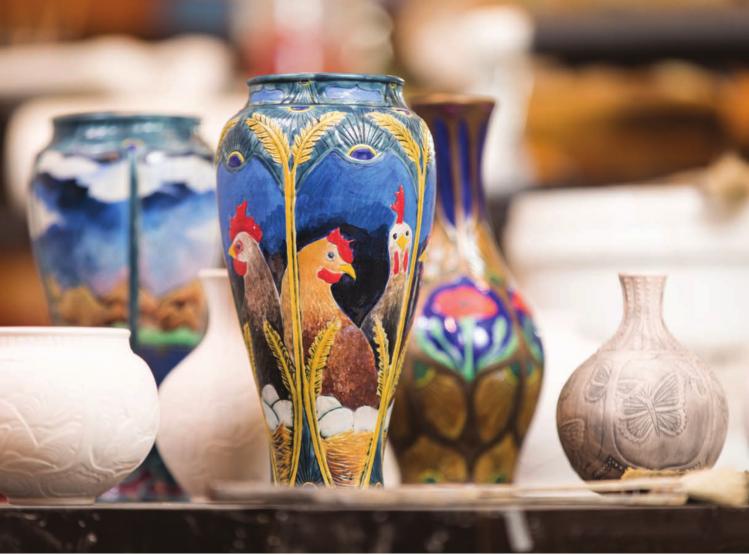
Scenes from nature are translated into exquisite pottery.
Potter Stephanie Young has always been drawn to art and the process of making in general. Owner of Calmwater Designs, Young found her passion in high school, where she delighted in art classes and would tuck herself away to work on projects. Art school, she says, was a “lawless” time—there she had access to the studio and clay at all hours of the day. “I snuck in, and could work in solitude after a waitressing shift or early in the morning before my comrades in creativity woke up to share the space,” Young says.
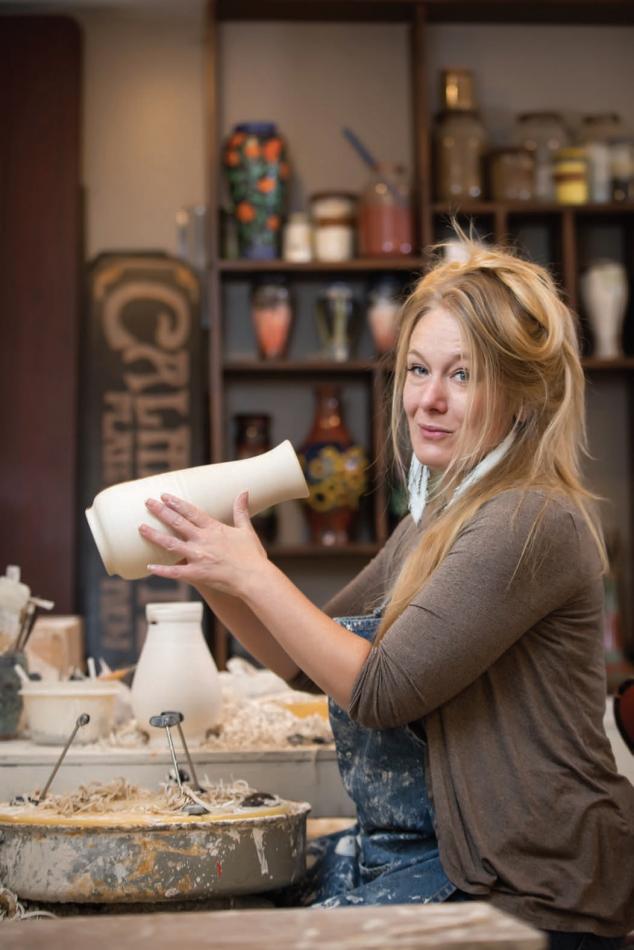
Potter Stephanie Young of Calmwater Designs Left: Young describes her work as “art nouveau, nature and inspiration with a smidgeon of sass.”
After finishing school, she enjoyed a period of speaking and teaching, and later the opportunity to visit places such as South Korea, Poland, Hungary, Austria and England, to name a few. As much as she loves traveling and exploring (which she hopes to do more of in 2021), she feels most at home in her studio, living the artist’s dream and creating inspired pieces for her insatiable collectors. That, to her, “is the ultimate win.”
New Hampshire Home [NHH]: What do you love most about your work?
Stephanie Young [SY]: I am delighted in the whole of it. I love the process of creation: taking a common thing (mud, albeit fancy mud!) and turning it into an uncommon thing. I love being able to turn something into an object of beauty that will long outlast me and its original purchaser. It feels a bit magical and incredibly important— every single time.
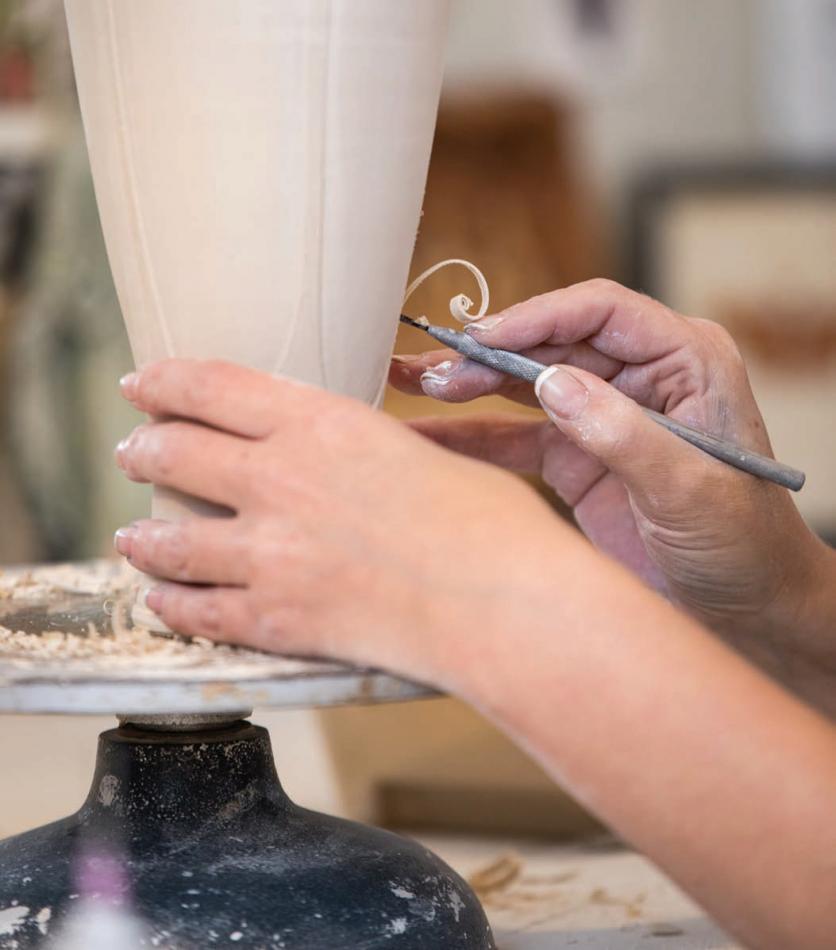
A delicate curl of clay peels away as Young works on carving a vase.
That is the entirety of the creative process, but within that, I love the details of the making. Creating the vase on the wheel is a sensory activity that demands your full attention—a dance of sorts. Carving allows me to flow creatively, creating geometric harmonies I find soothing. Within them, I weave natural subjects that soothe just the same. I love the solitude of this creative time. I love the glazing, finishing the work, as it will be presented to the world and meditating with brushstrokes.
A new part of my work that I love is meeting the people who collect my vases. The work has brought incredibly interesting and dynamic people into my sphere. Overwhelmingly, I see my collectors have chosen science as their life’s work—the sciences of nature, engineering and medicine. Collectors bring inspiration through conversation, as they have the same passion for their fields as I do for mine. I’ve learned about topsoil from collectors in Iowa, battery storage from patrons in Massachusetts and how to breathe through a snorkel from collectors whose home base is New Hampshire. Inspiration attracts inspired people, and I can’t think of another profession that would bring people of such wide and varied interests to my orbit.
NHH: From where (or what) do you draw the inspiration for your work?
SY: My works draw on inspiration from the art nouveau and aesthetic periods of design from the turn of the last century. I grew up with a mother who loved antiques, and that was my first experience with the line and flow of those times. I have since explored this time period more, and my particular fancy is spotting its characteristics in the ornaments of buildings. I have travelled extensively to places like Budapest and Prague to do so. The natural themes in my work are species of flora and fauna that resonate with me directly, through memories of my younger years or my current daily activities. I often use the species that surround me. An entomologist admirer in Florida inspired me to create a beautiful fresh piece of Madagascar Moon moths.
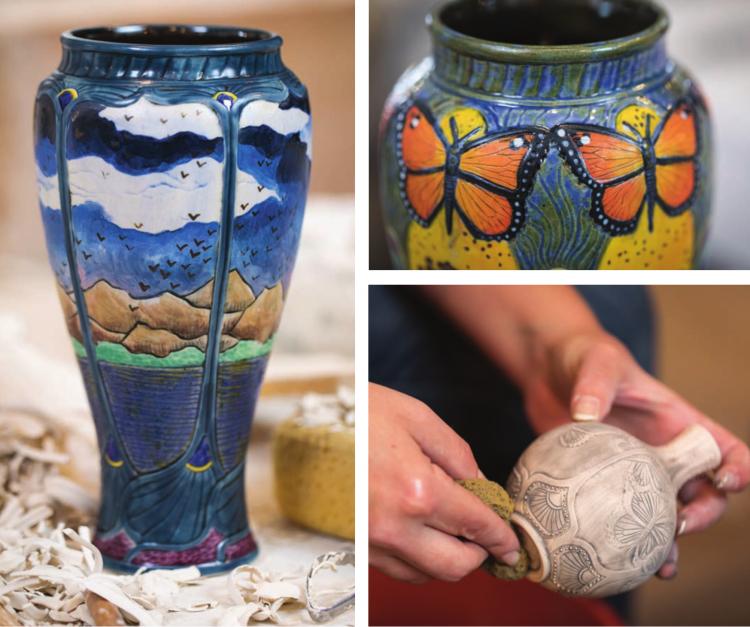
The more you look at Young’s intricate work, the more details you’ll notice. She finds inspiration in nature, she says, from “bugs and critters” and swans swimming in a reservoir to blooming morning glories and tomato plants growing in her own backyard. Bottom right: Young carves her designs before applying glaze.
I also look out from my neighborhood for inspiration. There was a tomato-growing extravaganza happening within my own yard this spring that inspired my carvings, as did my squash-growing experiment. The incredible variety of bugs and critters that were drawn to consume every poor squash or pumpkin that attempted to exist was noted and elevated to celebrity status on some vases. The blossoms of birdhouse gourds (which bloom at night and can be seen open first thing in the morning) knocked me over, and the careful watching of morning glories grow and bloom did the same.
My immediate walking route is dishwater-dull in inspiration, save for the funeral home that has a quite beautiful garden, a study in purples. I like to walk in various wooded areas, and yesterday’s big reveal was an abundance of swans in the reservoir, reminding me I am overdue to make another swan vase.
NHH: Are there particular seasons that inspire you more than others? If so, why?
SY: Each season lends its own inspiration, although spring speaks to me the most. It is the start of things, and it brings such unique potential and growth. My fierce love of spring carries me through the winter, and my inspirations for spring begin with the first frost of the fall. Winter helps keep me tucked into the studio and working toward spring’s arrival.
In 2020, my attention to the seasons—and what they present in their changing—was more apparent, given my lack of travel. This pandemic made space for me to witness the passing of time in my yard for the first time in more than a decade. I never realized how alive things are. We have arbitrary markers for the edges of seasons, but in reality, things are constantly on the move, growing and evolving, aren’t they? I think many who are reading this article also had this same unique experience.
NHH: Besides the more obvious end result—crafting a piece of beautiful pottery and satisfying your curiosity to create—what do you take away from your work?
SY: I get the satisfaction of moving matter and changing it to create a semipermanent thing that will long outlast me after I croak. I love creating beautiful things to show I was here. Humans all used to be makers and movers of matter, and now so many of our occupations are based solely in thoughts and actions, and dehumanized with technology. I’m old-fashioned and prefer matter with a sprinkling of the abstract. I am lucky to work with my hands.
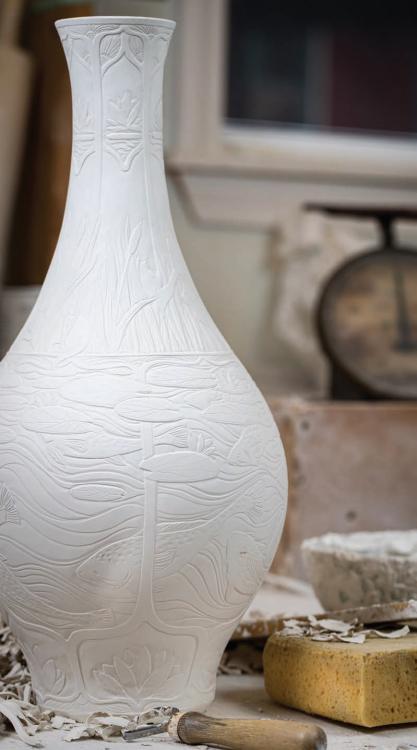
A vase in progress with a pond design carved into the surface.
I get the solitude to be with my thoughts during the making.
If creation goes well, it attracts people, and they then give me money in exchange for my efforts. Which, in turn, pays some simple bills and buys some simple pleasures … allowing me to create the next work.
NHH: What is your pottery process like? How does it begin?
SY: For me, it begins quite simply with the idea of small, medium or large. I choose the appropriate weight of clay and then throw the vase accordingly on the wheel. All my vases start just like this.
The carving often starts without a clear plan of action and is often a sketch on the vase itself. Sometimes, I’ll bring an inspiration to it (Madagascar Moon moths). Others, I will bring a more general idea to it. “Ocean? Forest? Sunset?” I’ll ask the vase. The carving unfolds from there, mathematical proportions and harmonies paramount in the design.
The glazing process is choosing the colors and textures that best fit the now apparent direction of the vase, and I choose those that will best add to its beauty and joie de vivre.
A lot of my work has areas of shine and matte. There are areas of dense, fine texture and sweeping lines of smooth architecture. The colors and textures I use create a balance within each work. Each is a contained unit. I enjoy creating my own balanced world while in unbalanced times. I’ll admire a smooth vase with a luscious glaze, and purchase a bowl crusted with ash and drips from a wood kiln, but the execution of the textural design elements on my own work is my jam.
The creative process is constant, day in and day out, as it is for all creatives. It needs matter to show itself to others.
NHH: How would you describe yourself? Artist? Maker? Potter? All three? Is there a distinction between them?
SY: I am a creator. The same energy that goes into the vases goes into my yard, my writing, my house and my conversations. When asked what I do, I reply with, “I make pottery.” And then I laugh, because it’s absurd I get to indulge in this delightful endeavor every day as a full-grown woman. “I make pottery” is indeed what I do as part of my super-fun spin on this globe. I like the simplicity of that.
NHH: Do you have a favorite project (or collection)? If so, what does it mean to you?
SY: I do not. I go through phases of enchantment with a design, color or subject. Sometimes that is explored through a couple of pieces, sometimes many. Sometimes a very special design runs its course and re-emerges years later for more pieces. On occasion, there is just one of a design that strikes me—like a smoked meat vase of 2018 that was cleverly decorated with sausages.
My patrons have favorite pieces and collections.
NHH: You’re also a teacher and speaker —what do you enjoy most about teaching classes?
SY: I miss my classes terribly! Stupid pandemic.
I
enjoy working with beginners, especially the sort who will ask, “What
is clay?” They are inspired, interested and eager to learn how they can
make their own things. I show them how and the technical skills to do
so. Watching their first pieces on the wheel, whether created by a kid
or a retiree, is a joy every, single time. Other students with more
experience will have some technical knowledge but are seeking their own
creative voice. These students I can work with creatively and
conceptually, so they can find their own way. If there is a direction
they’d like to go creatively, we can learn the technical skills to
support that.
Young applies glaze in a painterly fashion to prepare for the next firing of a work-in-progress.
I
don’t particularly enjoy speaking, as I fear I just ramble on without
direction. The audiences seem to enjoy it, though. I have yet to get
hooked off the stage or dodge rotten tomatoes.
NHH: How do you define your style?
SY: I define it as art nouveau, nature and inspiration with a smidgeon of sass.
NHH: How do you describe your technique?
SY: In
comparison with some potters, I use very simple techniques: I throw,
carve and glaze. Nothing special. The distinction is the amount of time
dedicated to the creating of each one— and the maker.
NHH: It seems you are creating more than just a piece of pottery. These feel like sweet, little stories.
SY: Over the years,
there is a narrative effect that is emerging. I can look at past works,
see the inspirations and remember where I was in my life while creating
them. I can see the influence of people, places, times and books. When
viewing a large body of my work in a collector’s home, it feels very
intimate—almost like a diary.
Many
of these pieces are collected by people who have a personal story that
makes the piece appeal especially to them—like a childhood experience,
or a particular flower or butterfly. I love that. It’s a way of
connecting that I never anticipated.
All this is an interesting read, isn’t it?
The words, the vases, the whole of it.
This life thing. NHH
RESOURCE
Stephanie Young • Calmwater Designs Pottery calmwaterdesigns.com