piccalilli |'pika,lile’| noun (plural piccalillies or piccalillis) a relish of chopped vegetables, mustard and hot spices
Here’s my mother on the one great cooking day of her year.
Call her mid-fifties, maybe older. Not tall, five feet six inches. A brown, auburn tint to her hair. Green eyes. An Irish woman, Mary Deborah Brennan, from Country Cork. A woman who—when losing at cards—would stand and circle her chair three times, believing that it changed her luck. A woman who birthed seven children, five boys and two girls, who remained by my father until her last day, who woke me the morning after JFK won by announcing that the new president of the United States was none other than John Fitzgerald Kennedy.
As charming as she was in countless ways, she was a deadly cook. Cooking for seven children night in and night out sent her in the direction of one-pot meals. Spaghetti, stew, meatloaf. For all the enlightenment spreading around in the 1960s, with new attitudes about race and women and foreign wars, foodie-ism was a rare, exotic thing. Think instead Wonder Bread and Twinkies, Hamburger Helper and Kool-Aid. Maybe in Paris the French knew how to cook and eat, but in my small dot of central New Jersey, in a house stuffed to the soffits with kids, Duncan Hines and Chef Boyardee dominated the cupboards.
Except for one day each year. Everything about this single day in October broke the routine. Perhaps it resulted from deep end-of-season discounts on vegetables at the local farm stand, or perhaps it resulted from the change in the air, the fresh, sweet broom of winter flicking at us from the corners of summer’s end. But on a certain Saturday, my mother turned into a Celtic banshee, a fairy woman of the mist and mound!
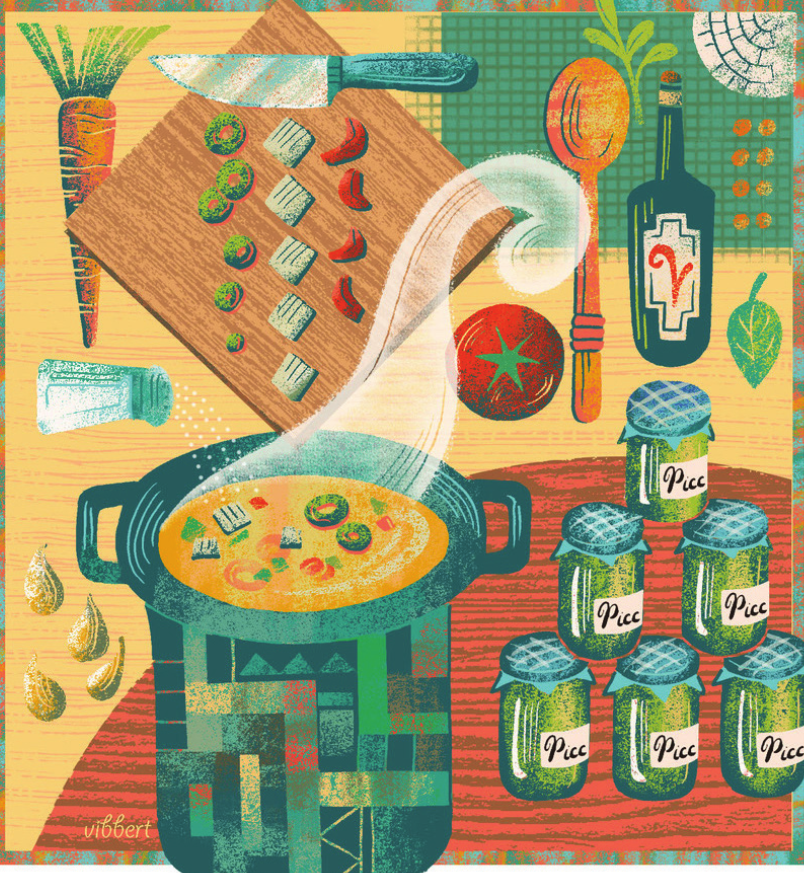
She rose early, already off to the market before any of us awoke. Then she returned, the door kicked open, the windows raised, the scent of dying leaves part of it all. She took out the big pot, the pot that lived in a corner cupboard for the entire year until this moment, and sloshed it clean in the sink. I was the youngest of the seven children, and my mother assigned me the task of attaching the meat grinder to the pull-out cutting board—do they still make that in the modern kitchen?
It was tremendously useful, and we wouldn’t have considered it a complete kitchen without a pull-out board for cranking through onions and celery, peppers and garlic.
Suddenly, the kitchen— a factory all year—became a live, forceful thing! Everyone in the house ended up in the kitchen, stirring, mixing, helping to create my mother’s one culinary gift to the world: piccalilli sauce. This was my mother’s day, and she chopped and mixed, stirred and sipped, dunked clear jars in steamy water and pulled them out with clicking tongs.
Piccalilli! Heck, it was fun to say! She canned the whole lot, rubber gaskets, careful tops, burned fingers.
It’s a great regret in my life that I never asked her why piccalilli, why this strange sauce for dry meats, where had she learned to make it? But the rise and fall of that day, the sweet fragrance of the kitchen, the image of my mother somehow girlish in her commitment to a condiment, of all things, has stayed with me for decades. Piccalilli!
By the end of the night, we had two or three dozen jars set out on the counter, the great ruddy contents like a season’s bounty handily captured before it had a chance to slip away. NHH