Expressions in Wood
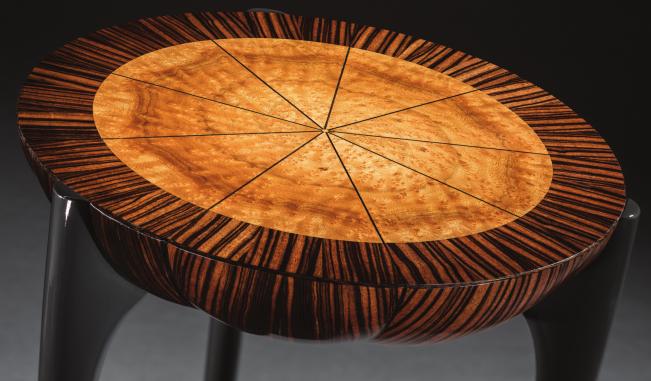
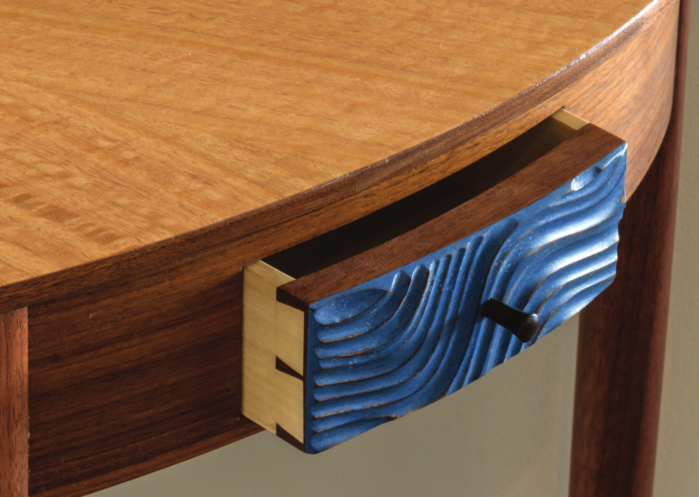
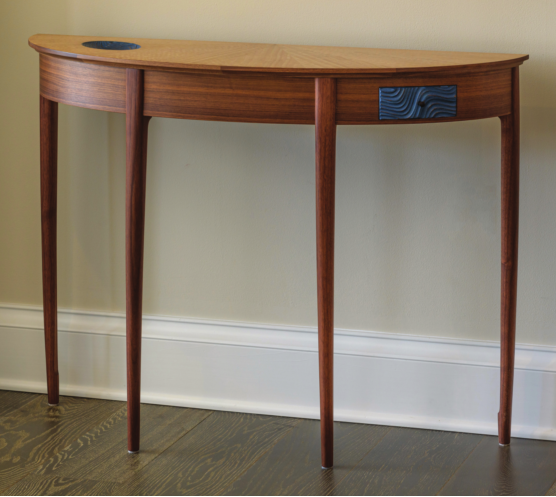
Above and below: The “Power of Nine” table by Owain Harris, a juried member of both the New Hampshire Furniture Masters and the New Hampshire League of Craftsmen Owain Harris has never ceased to be amazed by the ability of wood to be both transformed and transforming.
To some extent, says self-taught furniture and cabinetmaker Owain Harris, he found his passion by accident. None of his family are woodworkers, he didn’t find inspiration in a high school shop class (he wanted to be a writer back then), and it wasn’t even, as he says, “on my radar.” In the mid- ’90s he was living in Portsmouth, enjoying the punk rock music scene and working at the Elvis Room on Congress Street. “I loved working there,” he says. “It was super fun. But at the age of 22, for some reason, I had this sudden sense that I maybe needed to do something else that didn’t involve slinging beers.” In the back of his mind, he says, he’d long held a certain idea—he wanted to build his own house.
Coincidentally, as Harris was thinking about making a change, New England was in the midst of a building boom. In 1997 he joined a framing crew, and soon found that he enjoyed “having something tangible at the end of the day.”
He spent several years working as both a remodeler and finish carpenter, and in 2008, he made the leap to the shop as a full-time furniture and cabinetmaker. In addition to being a juried member of the New Hampshire Furniture Masters (who are celebrating 25 years in 2020), he is also a juried member of the League of New Hampshire Craftsmen, and he teaches at the Center for Furniture Craftsmanship in Rockport, Maine.
New Hampshire Home [NHH]: What do you love most about your work?
Owain Harris [OH]: I think as a species we’re drawn—we’re driven—to make things. It’s not a coincidence that we were painting on cave walls almost as soon as we were making tools. I think as a species, we have an inherent drive and desire to express ourselves through various means, and for whatever reason, I’ve fallen into furniture making being the way I do that—and I’m very happy about that.
The thing that appeals to me about furniture making is that it’s a really interesting mix. [There’s the] technical and construction side, which appeals to the right side of my brain, where I am a fairly logical thinker—I like to break things down into steps, and I love the problem-solving aspect of furniture making—this one of the reasons why I make tend to make really complicated pieces of furniture. It also fulfills the right side of my brain—creativity, expressing myself and all of those things. It’s really ended up being sort of a complete package for me, which is exciting.
NHH: Besides the more obvious end result—crafting a piece of beautiful furniture and satisfying your drive to create—what do you get out of it?
OH: Connections with people. I think that in itself is such a rare and important thing. Making connections through something that you brought forth into the world—that’s pretty exciting and pretty powerful. […] The opportunity to make things of your own design, to bring them into the world and have people respond to and appreciate it (and, you know, ideally be willing to give you money for it), and then take it home and cherish it—that’s an incredible experience, and it’s one that really doesn’t get old.
NHH: When designing and building custom furniture or cabinetry for clients, how does that process begin?
OH: I don’t really have a rigid framework for how that process unfolds because it varies from client to client. But there is sort of a logical series of steps that takes you from point A to point B. Typically, most of the commission work I do is because someone has a need for a dining table, or a cabinet, or they have a space they want to fill. Usually the initial discussions are along the lines of, “OK, what do you want? What is it that you're looking for? What are your goals? Do you have any specific things that you have seen out in the world that inspire you?” I find that to be very helpful. Or, there might be [a specific piece of] my earlier work that they’ve seen—some sort of starting point. I think there’s often a misconception that being given carte blanche to create something is the best, but actually, I find that more intimidating. It’s nice to have a starting point to understand what their aesthetic vision is.
NHH: There are a few words or terms that have been used to describe you— artist, artisan, furniture maker. How would you describe yourself, and do you think there’s a distinction between artist and maker?
OH: Honestly, I think that sometimes there is very little distinction. I mean, if you go to the MFA or the Met in New York or the V&A in London, these museums are filled with these sorts of cultural objects that, at the time they were made, were largely made to fulfill a practical need. The fact that they express something inherent to the maker elevates that object to some degree, but I doubt very much that most of the people making those objects considered themselves artists. But we have certainly elevated them, and the same could be said for furniture now.
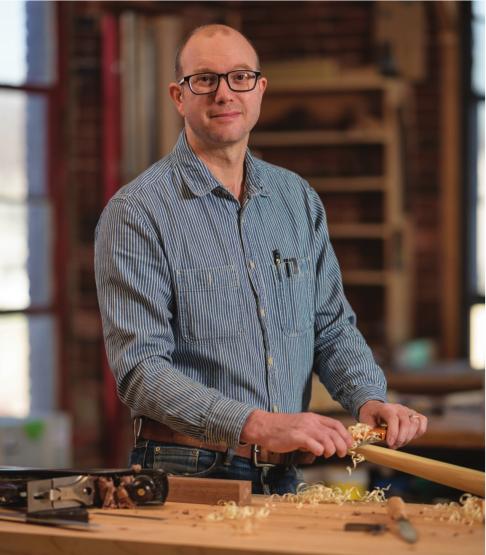
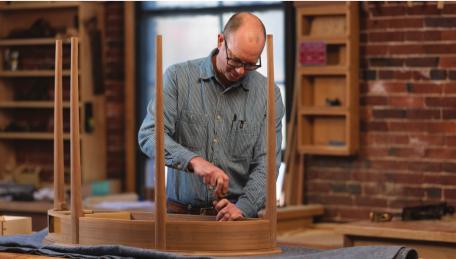
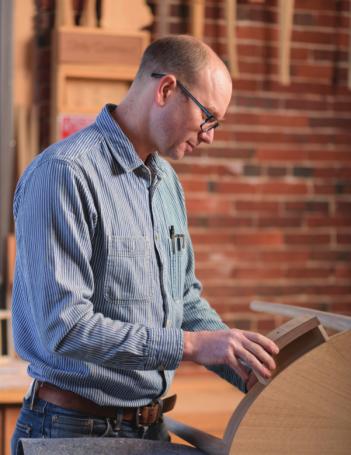
Owain Harris at work in his Deerfield shop where he builds custom furniture and cabinetry.
I’ve never been a hundred percent comfortable calling myself an artist, though to some extent, I embrace the tropes of it—a customer might call my shop a studio, I show my work in galleries, and certainly if a potential client or collector sees it as a piece of art, then I’m perfectly happy that they feel so. But I don’t know—I kind of go back and forth on it, to be honest. Predominantly I just think of myself as being a furniture maker, and I let other people determine whether or not it’s art.
I think there’s a big debate about the difference between art and crafts, and I think you can drive yourself crazy trying to draw distinctions. I think to some degree there are distinctions, but I think that they probably fall away at some point, and there’s more similarity than anything else.
NHH: Do you have a favorite project? If so, what does it mean to you?
OH: I mean, a lot of the stuff I build ended up at some point with me thinking, “Oh I've bitten off way more than I can chew,” but I managed to pull it off. Certainly “Escape Velocity” falls into that category [pictured on page 94]. There was a certain point in that job where [I thought], “Wow, I don't even know if I can do this,” but you just keep at it. I think that piece is a watershed piece in some ways for me, because it was the first piece I built as a member of the Furniture Masters, and I was exhibiting at their big gala.
Above: Harris at work on the textured demilune table pictured below—what looks like a circle on the tabletop is actually an indent, perhaps an ideal spot for placing your keys.
I think up until that point a lot of the spec work I’d been building had been so deeply rooted in Art Nouveau ideas and some other periods—I hadn't really allowed my own voice to come through. I think that’s really the first piece where I had a very well-articulated idea of what I wanted to convey, and I think I did that successfully. Subsequently, it was a very successful piece, and one that I was very proud to show. […] For many ways, that was sort of a turning point for me, as both a designer and a maker.
NHH: You’re also a teacher—what do you enjoy most about teaching?
OH: Any time when I’m sort of head down in my own shop, and I’m just going for months and months, it can start to feel like work again, and going into an environment where I’m surrounded by people that are at the beginning of their journey, and are unbelievably excited about it, there’s just so much passion there—and the scales sort of fall from your eyes a little bit, and it’s a visceral reminder of how exciting and how fun this is to do.
I often find that the process of breaking down what I do into a series of steps, and the time I spend conveying that to someone else, helps me to understand what I’m doing—I think it makes me a better furniture maker. And also, the nice thing about the Center for Furniture Craftsmanship, which is where I predominantly teach up in Rockport, Maine, the caliber of people that come through that space is phenomenal. It’s an amazing brain trust.
And I do think there’s just something fundamentally rewarding—after having accumulated this knowledge over two decades—about being able to pass that on to another generation that’s excited about the process. Having the opportunity to help shape what the next generation of furniture making looks like in whatever small way, not to be grandiose about it. I don’t think I’m influencing a generation or anything, but I do have some effect, and that’s exciting and rewarding.
NHH: From where (or what) do you draw inspiration? OH: It would be tempting to say ideas just popped into my head, but I don’t think anything gets created in a vacuum. I’m not somebody who says, “Oh, well, I draw inspiration from the New Hampshire woods.” I mean, I do, certainly, but I think it’s less direct than that. I think I find inspiration in lots of places—certainly in the work of the other furniture makers, other artists. One of the things I am genuinely missing the most these days is museums. I find so much inspiration not just in furniture in museums but paintings and sculptures.
My wife is an avid flower gardener, and we have a huge garden, and I find a lot of inspiration in the sort of architectural aspects of flowers. Right now I am really obsessed with poppies—more so how the poppy looks after all the petals fall off; the big seed head that’s suspended on this impossibly thin, little stalk that’s got these delightful little waves to it. I’ve been trying to figure out how to express that somehow. I’m not terribly interested in mimicking things in nature; I’m interested in the way certain lines lie, and certain proportions and architectural elements.
NHH: How would you define your style?
OH: I don’t know if I really have an answer to that. To some extent, I’ve always resisted the idea of a definition. Many of the furniture makers that I most admire are makers who have been constantly able to reinvent themselves, and sort of defy any kind of stylistic terminology. I think in my artist statement on my website I describe it as “approachable elegance.”
I think most of the work that I produce has certain attributes, in the sense that I think it’s largely fairly elegant, and I think it’s rooted in a pretty traditional foundation of understanding how proportion works. I’m not radically reinventing these furniture forms. In many ways I think my work, even the stuff that’s kind of out there, is traditional, in the sense that it has traditional proportions and it’s recognizable as a table, or as a chair, or a dresser—as whatever the piece happens to be. I don’t think my style falls neatly into any particular category.
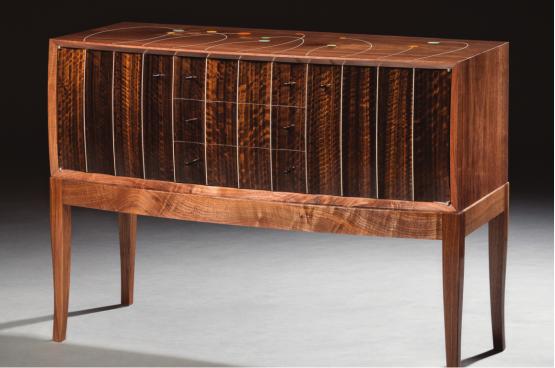
“Escape Velocity,” the piece Harris says was his “watershed” moment as a designer and furniture maker.
The more I understand the history of furniture design, the more I realize that there’s nothing new, really—it’s just reinvention and reinterpretation. I think it’s impossible to design anything new, strictly speaking. When I teach, to the extent that I teach design at all, which I don't do a lot of, I tell my students to focus more on good design rather than new design, because I think you can beat yourself up trying to reinvent the wheel.
NHH: When it comes to technique, would you call yourself a traditionalist, more modern or a mix of both?
OH: I actually think it’s incredibly important as a maker in the 21st century to be flexible enough to be able to take advantage of modern materials, machines and techniques, while also having a foundational understanding of hand tools and their use. I try to teach both sides of the equation at school, and I gave a presentation at IWFS (the big woodworking trade show) in Las Vegas last summer on the subject. If an 18th-century cabinetmaker was transported to my shop, he would probably be amazed by some of the things he found—the CNC router, for example— but he would feel right at home in the bench area where I maintain and employ a collection of hand tools that haven’t changed dramatically in design for hundreds of years.
NHH: It seems you are creating more than just a piece of furniture— these feel like heirloom pieces.
OH: I think that’s the goal—that’s the idea. They’re certainly built with that in mind. That’s the thread that binds everyone in the community of makers I’m a part of here in New England—not just the Furniture Masters, but also the League of New Hampshire Craftsmen. Building furniture, using the kinds of materials and techniques that will end up producing a piece that will last generations. My hope is that I’m not building things that are fleeting. Both in the way they’re manufactured and the way they’re designed, they’re something that can bridge generations. NHH
RESOURCES
O.H. Harris Furniture Maker • (603) 781-1315 owainharris.com
League of New Hampshire Craftsmen (603) 224-3375 • nhcrafts.org
New Hampshire Furniture Masters (603) 898-0242 • furnituremasters.org