Italian-Style Fall Soups
Hearty, comforting dishes that satisfy both body and soul.
 Fall is, without question, the most enchanting time of the year for me. Crisp, cool air and brilliantly painted landscapes by Mother Nature put me in the mood for finding my favorite cozy sweater and sitting by a crackling fire absorbed in a good book.
In the kitchen, cravings for some serious soup takes over, and I often gravitate to making some of my favorite heirloom Italian varieties.
Italian soups, like many others, were born out of what ingredients were on hand, what we call “kitchen sink soup.”
A handful of beans, soup bones, some herbs and even cheese rinds were the foundation of soup. I always loved some of the names attributed to soup, like the endearing “soup with bread under it” that my Aunt Santina’s mother Mrs. Belurgi made. I called her Mrs. B, and her soup made with stale slices of coarse bread, Swiss chard and tomatoes always intrigued me. Not only was it delicious, it was served on a platter (not in a soup bowl) and was thick enough to eat with a fork!
As years went by and travel to Italy grew more frequent, I became more acquainted not only with a wide number of regional soups, but with the unique techniques that Italians use. Often they would mention, “gli odori,” meaning the flavor enhancers, those key ingredients that a serious cook must have to make la zuppa! That meant onions, carrots, celery and parsley were musts for many soups.
In the alpine region of northern Italy, beans play a big role in hearty soup, and often are puréed and used to thicken it. In the rich gastronomic region of Emilia Romagna, home to Parmigiano- Reggiano cheese, even the rinds go into soup. In Liguria, famous for pesto, no serious minestrone soup would be without it. Just about everyone I know loves wedding soup, made with marble-size meatballs and escarole.
Ingenious in every way, passatelli soup pasta—made from breadcrumbs, egg, lemon zest and grated cheese— was formed into a hard dough and grated. This was then added to boiling chicken broth.
In the tomato-rich regions of the south, tomatoes, fish and seafood form the basis of many soups, and their distinct rich flavors were coaxed out using the trimmings from fish and shellfish.
For Italians, la zuppa fa sette cose. This old proverb means “soup does seven things: quenches thirst, satisfies hunger, fills you up, aids in digestion, makes your teeth sparkle, colors your cheeks and helps you sleep.”
Buon appetito! NHH
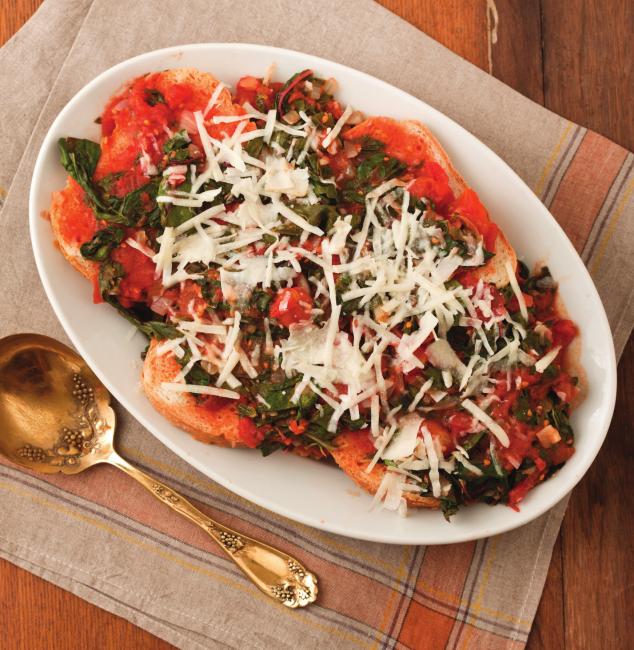
Minestra con Pane Sotto (Soup with Bread Under it) Serves 8–10
Aunt Santina gave me the recipe years ago for this unusual soup that her mother, Mrs. B, used to carry to the workers in the fields near Veroli, in the region of Lazio. The story goes that Mrs. B would twist a large kitchen towel around her head and tie it securely. A large bowl of this soup would be propped atop her head and off she went to the fields, arriving just before the church bells tolled at noon. When she arrived, the workers knelt, prayed and then ate this soup.
¼ cup extra-virgin olive oil
1 medium onion, chopped
2 cloves garlic, chopped
8 cups chopped fresh plum (about 5 pounds) or canned tomatoes
2 or 3 sprigs fresh basil
Salt, to taste
Freshly ground black pepper, to taste
1 pound Swiss chard, stems removed and leaves torn into small pieces
Dense, country-style bread, cut into sixteen 1-inch-thick slices
1 cup grated Pecorino Romano cheese
1. In a large pot, heat the olive oil. Add the onion, and cook over medium heat until it is soft.
Add the garlic, and continue cooking until it softens. Add the tomatoes, basil, salt and pepper. Stir well and let simmer, covered, for 20 minutes.
2. Meanwhile, bring a large saucepan of water to a boil. Add the Swiss chard, and cook until the leaves wilt. Scoop the Swiss chard out of the water and add it to the tomato mixture. Stir well, and simmer for 5 minutes.
3. Place a layer of 4 bread slices on a rimmed platter. Spread just enough of the soup over the bread to cover it. Sprinkle with some of the cheese. Make a second layer of bread, tomato soup and cheese. Continue making layers until all the bread and soup is used.
4. Let the soup stand for a few minutes so the bread soaks up some of the liquid. Scoop from the platter to serve.
Recipe from “Ciao Italia: My Lifelong Food Adventures in Italy”
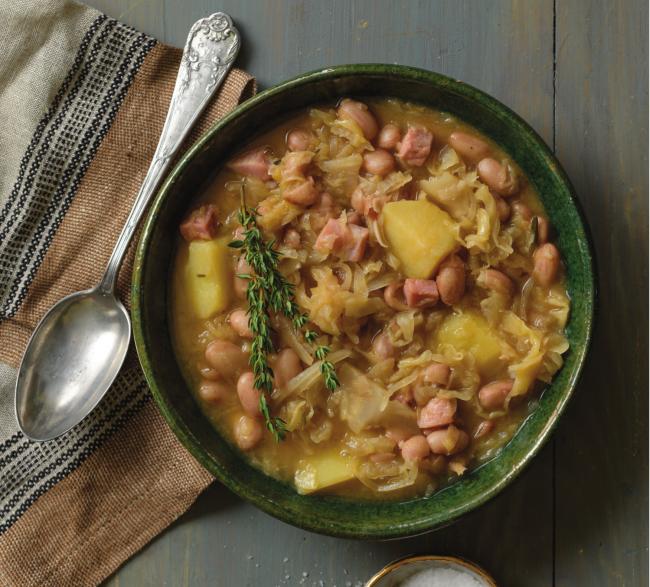
Jota (Trieste Bean Soup) Serves 6–8
Jota is an ancient dish from Trieste that, over the centuries, has undergone very few changes. But the most significant dates back some four centuries, when potatoes were introduced. Jota was considered a peasant dish, as it is made with leftovers and two common ingredients: beans and sauerkraut.
2 cups dried borlotti beans, covered with cold water and soaked overnight
8 cups vegetable broth Small bouquet fresh herbs, such as thyme, bay leaf, rosemary and sage
2 all-purpose potatoes, peeled and cut into 1-inch dice
2 tablespoons olive oil 1 small onion, peeled and diced
1/2 cup finely diced smoked ham
1 can sauerkraut, drained and rinsed
2 tablespoons butter
¼ cup flour
Salt and pepper to taste
1. Drain the beans and place them in a pot. Cover with the vegetable broth. Add the herbs and bring to a boil. Cook over a medium boil until the beans are almost tender. Then, add the potatoes and continue cooking for about 20 minutes.
2. Heat the olive oil in a medium skillet. Add the onions and ham, and cook until the onions wilt. Stir in the sauerkraut and cook for about 5 minutes.
3. Heat a small skillet and melt the butter. Add the flour, and whisk the mixture to form a brown paste.
4. Add the onion mixture to the beans and combine well. Over a low heat, whisk in the brown paste and heat the soup until hot. Correct the seasoning with salt and pepper.
Recipe from “Ciao Italia: My Lifelong Food Adventures in Italy”
Minestrone Soup Serves 8
Ligurians love vegetables, and it shows in their signature soup, minestrone—which means “big soup.” It is often eaten on Sundays and at room temperature. Pesto gives the soup its classic and elegant taste, and is best made with a mortar and pestle. To make pesto, Ligurians use the smallest leaf basil they can find because its flavor is most intense.
¼ pound white cabbage, chopped in small pieces
2 carrots, diced
2 leeks, white part only, sliced into thin rounds
2 tomatoes, diced
2 small zucchini, diced
1 medium onion, chopped
1 clove garlic, minced
¼ pound green beans, cut into thirds
2 potatoes, peeled and diced
1 small bunch parsley, chopped
¼ pound presoaked and precooked borlotti beans
¼ cup olive oil
1 small Parmigiano Reggiano cheese rind (optional)
½ cup soup noodle, such as orzo or ditalini
1 tablespoon
Pesto alla Genovese
Salt, to taste
Grated Parmigiano Reggiano, for sprinkling
1. In a soup pot, bring 2 quarts of water to a boil. Add the vegetables and parsley. Cook over medium-high heat until tender. Add the borlotti beans, olive oil and cheese rind (if using). Stir in the noodles and cook over medium-high heat until they are al dente.
2. Stir in the pesto sauce. Add salt to taste.
3. Serve in bowls with a grating of the Parmigiano Reggiano cheese
Pesto alla Genovese
1 bunch basil (2 cups packed leaves)
Coarse salt
2 tablespoons pine nuts
1 clove garlic
1/3 cup grated Pecorino, Parmigiano or Grana Padano cheese
2-4 tablespoons organic or extra-virgin olive oil, divided
1. Grind the leaves in a mortar and pestle with a few grains of salt until it is pulpy.
2. Add the nuts and grind to a sauce consistency. Transfer to bowl.
3. Stir in cheese and enough olive oil to make a dense, but free-flowing, sauce.
Recipe from ciaoitalia.com
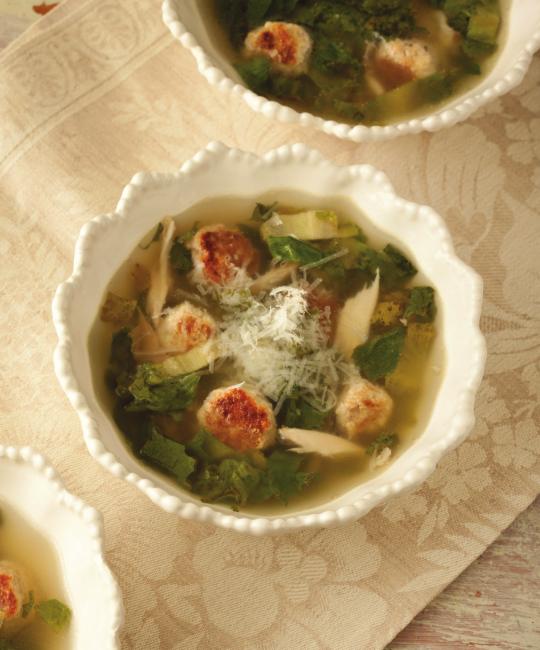
Minestra Maritata (Wedding Soup) Serves 8
Who has not heard of wedding soup? It was served as a first course at my own wedding, but it was never intended for such an occasion. Wedding soup got its name from the fact that all the ingredients go together well—just like a married couple. There are so many watered-down versions of this soup, but here is what was served at my wedding.
1 large onion, peeled
10–12 whole cloves
2 large celery stalks with leaves, cut into quarters
2 large carrots, scraped and cut into quarters
1 large bay leaf
1 small bunch parsley
3 fresh sprigs thyme
3 pounds chicken wings
1 large lemon, thinly sliced into rounds, seeds removed
1/3 cup fresh breadcrumbs, crust removed
3 tablespoons milk
2 tablespoons extra-virgin olive oil
1/2 pound ground veal or chuck
1 small egg
1/4 cup grated Pecorino cheese, plus more for sprinkling
1 garlic clove, minced
11/4 teaspoons salt, plus more to taste Grindings of black pepper
1 head escarole, cleaned and coarsely chopped
1. Stud the onion with the cloves, and place it in a large soup pot with the celery, carrots, bay leaf, parsley, thyme, chicken wings and lemon slices. Cover the ingredients with water and bring to a boil.
2. Turn the heat down to simmer so the water is barely moving.
Cover the pot and cook for 1½ hours.
3. Preheat oven to 350ºF. In a small bowl, combine the breadcrumbs with the milk and set aside.
4. Grease a rimmed baking sheet with the olive oil. In a medium bowl, add the veal or chuck, egg, ¼ cup of cheese, garlic, 1¼ teaspoon of salt, a grinding of pepper and the soaked breadcrumbs. Make the meatballs the size of marbles and place them on the baking sheet as you make them.
5. Bake the meatballs for 20 minutes or until lightly browned. Transfer the meatballs to a bowl and refrigerate them.
6. Remove the chicken wings from the pot and set aside on a cutting board. Strain the broth through a sieve, pressing on the vegetables to extract as much liquid as possible. Discard the solids and return the broth to the pot.
7. Bring to a boil, and stir in the escarole. Cook 3–4 minutes just until the escarole wilts. Add the meatballs to the broth. Remove the meat from the chicken wings, and add it to the broth. Correct the seasoning and add grated Pecorino cheese on top. Serve hot.
Note: The meatballs can be made three days ahead.
Recipe from “Ciao Italia Family Classics”